

The Carmack Optimization
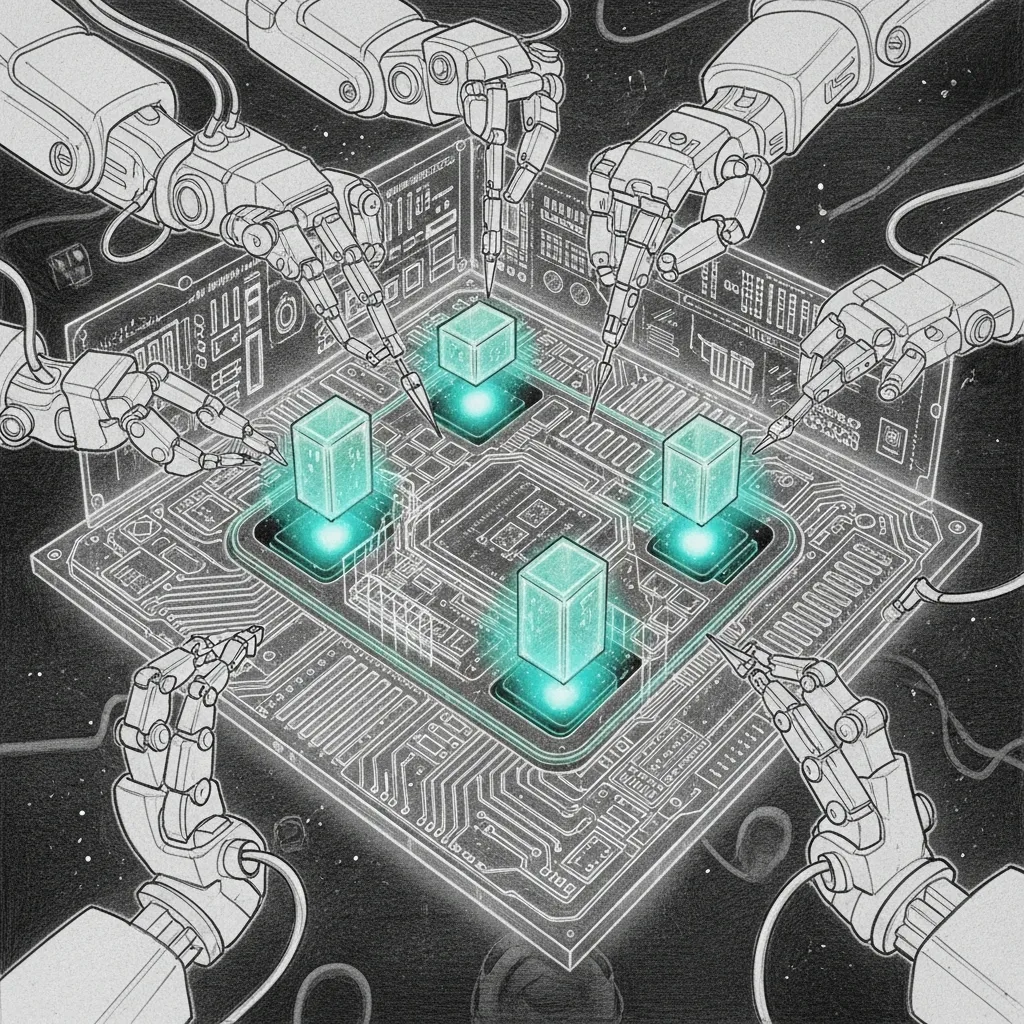
Apple’s way of telling you the GPU has given up on you as a person is a terse Broken Pipe from MTLCompilerService. Not “out of memory” — nothing that civilized. We saw that message a great deal in the spring of 2026, training a 27-billion-parameter model on a laptop. Which is either visionary or reckless. For a while, it was both.
Date: 2026-04-02 Status: Implemented (history); pipeline re-pointed at a 7B coder since
The story below is the Council distillation run — Qwen3.5-27B, distilled from Claude Opus, trained on the Mac through March and April 2026 (the benchmark JSONs still sit in coding-llm-bench/results/). That run is retired. The same mlx-finetune plumbing is alive today, re-pointed at Qwen2.5-Coder-7B-Instruct-4bit — a smaller model with a calmer appetite. Where the live 7B config differs from the 27B war stories, this page says so, because a reader who opens lora_config.yaml expecting 32 layers and finds 28 will conclude the whole page is fiction. It isn’t. It’s just older than the config. (The wider arc of what these runs taught us lives in Training Lessons.)
The 27B pipeline crashed mid-training with Metal GPU errors that read like resignation letters from the shader compiler. Inspired by John Carmack’s line — “if you don’t understand the hardware, you don’t understand the problem” — we stopped guessing and profiled everything. Four failure modes fell out. Each one only appears when you push consumer silicon past the edge of what Apple probably imagined anyone would do with it.
Sequence length discipline
Section titled “Sequence length discipline”The Issue: Variable-length training examples make MLX compile a fresh Metal shader for every unique sequence length it sees. A few hundred distinct lengths means a few hundred graph shapes means a few hundred shader compilations, and MTLCompilerService eventually throws its Broken Pipe — Apple’s polite way of saying “I give up.”
The Fix (live): The 7B config pins a single ceiling — max_seq_length: 1024 — and MLX truncates anything longer. The training log is honest about it: Some sequences are longer than 1024 tokens. The longest sentence 4254 will be truncated to 1024. One length cap collapses the shape explosion to a handful of variants and the compiler stops panicking. The difference between “crashes after 200 steps” and “runs to completion” was, embarrassingly, mostly about sequence length.
Graph stability
Section titled “Graph stability”The Issue: Deep LoRA layers with high gradient accumulation created an explosion of tiny memory allocations. The GPU spent more time managing memory than doing math — like a librarian who spends all day organizing the card catalog and never actually shelves a book.
The Fix: Once the length cap stabilized the graph shapes, the allocation pattern stopped thrashing. The live 7B config trains all 28 layers at 1024 context with grad_accumulate: 2 (effective batch of 4) and never goes near the wall — Trainable parameters: 0.303% (23.069M / 7,615.617M), runs to completion in one to two hours on the M4 Pro. The computation graph went from a Jackson Pollock painting to a circuit diagram. (The original 27B run pushed deeper and wider before this settled; the surviving config is the calm one.)
The dataset is smaller than the legend
Section titled “The dataset is smaller than the legend”The Issue: Early plans imagined a huge synthetic corpus — every agent generating hundreds of examples. The build that actually shipped is humbler and better: build_training_data.py walks real code on disk (openclaw-skills bash, ~/.sanctum infra scripts, the firewalla bridge JS, runner Python, icloud-organizer TypeScript, LaunchAgent plists) and turns each file into an instruction/response pair. The result is 459 training + 52 validation examples — two orders of magnitude under the legend, and every line of it is code that already runs in the haus.
The Reality: The generator is single-threaded today, which is fine: globbing a few hundred files and templating prompts takes seconds, not coffee breaks. The embarrassingly-parallel collect_files() / create_chunk_pairs() loop could be wrapped in a multiprocessing.Pool(os.cpu_count()) to leave the GIL watching from the sidelines — but at 511 examples there is nothing to optimize yet. We earned the right not to.
Hardware profiling
Section titled “Hardware profiling”The Issue: Configuration changes were vibes-based. “This crashed, so reduce rank. That didn’t crash, so increase context. Repeat until the model converges or you lose patience.” This is not engineering. This is dowsing.
The Fix: Stop arguing with the GPU and ask Apple Instruments what it’s actually doing. xctrace and the Metal System Trace template ship with the Xcode tools already on the box, so the profiling run is one line wrapped around the real training invocation:
xcrun xctrace record --template 'Metal System Trace' \ --output finetune/train.trace \ -- python -m mlx_lm.lora --config finetune/lora_config.yamlReal-time ALU occupancy, shader compilation time, unified memory bandwidth. The profiler doesn’t care about your intuition — it cares about what the silicon is actually doing. Carmack would approve.
How we know it works
Section titled “How we know it works”Today the proof is the artifacts on disk, not a test harness — finetune/train.sh runs end to end, training.log records the loss curve and the truncation warnings, and the adapter lands in finetune/adapters/. To confirm the trained adapter actually speaks, serve it and ask:
python -m mlx_lm.server \ --model /Users/neo/Projects/mlx-finetune/models/Qwen2.5-Coder-7B-Instruct-4bit \ --adapter-path /Users/neo/Documents/Claude_Code/coding-llm-bench/finetune/adapters# then POST a /v1/chat/completions payload to 127.0.0.1:8080 and watch it streamThat is where an adapter stops being a training artifact and starts auditioning for a seat — the crown itself is decided elsewhere, at the champion gate. A committed tests/test_e2e_pipeline.py that pins each failure mode dead — data generation, the length cap, and live inference against a real mlx_lm.server — is the honest next step, not a thing that exists yet. See the escalation note. Because the only thing worse than a crash at 3 AM is a crash at 3 AM that you thought you’d tested against. Bugs that expensive shouldn’t get to come back — but a test can’t keep a bug dead until somebody writes the test.