

2026-04-07: Provider Overhaul
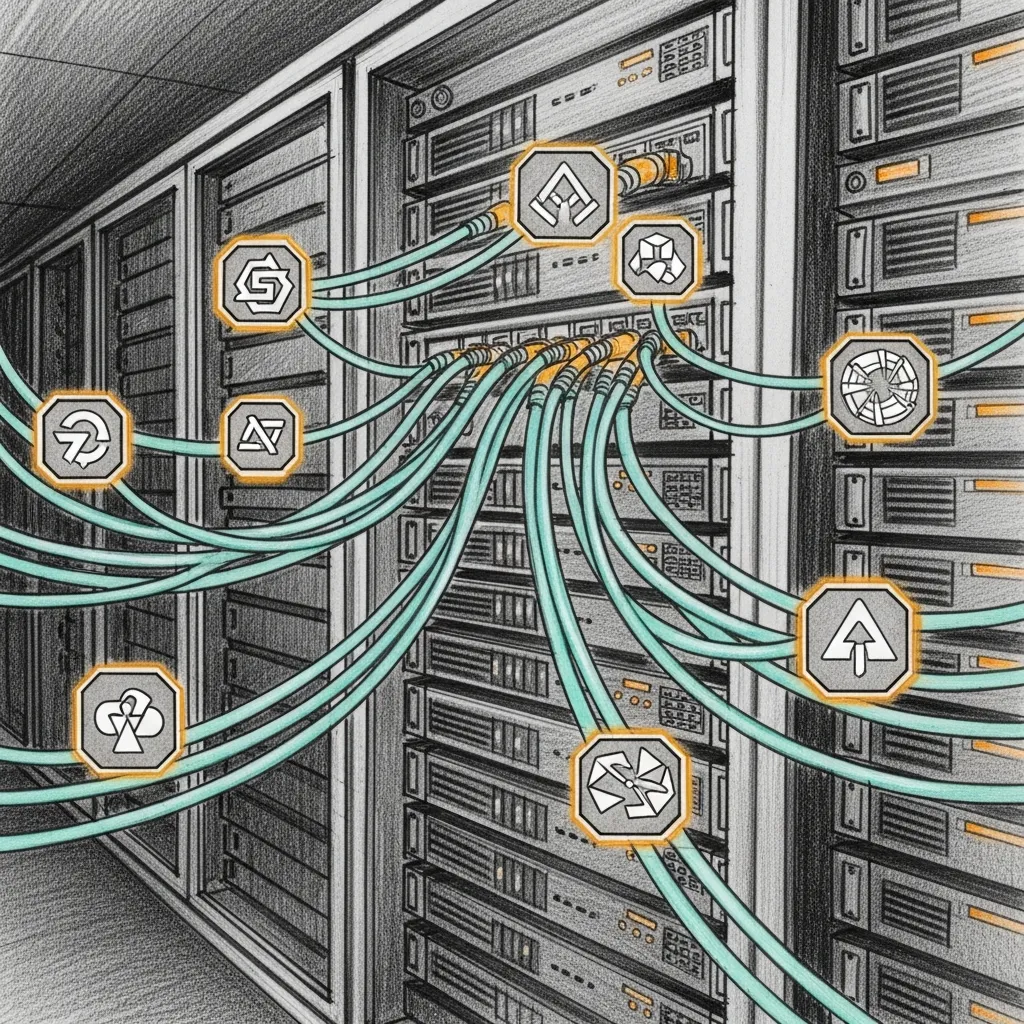
The haus woke up routing every LLM request through OpenRouter. One aggregator. One API key. One quiet single point of failure that nobody had looked at in weeks. By the time the work was done, the proxy had five independent paths to inference, a fallback chain deep enough to survive any single provider going dark, and a Signal integration that no longer leaned on a Docker container held together by port mappings and optimism.
This is dated material — the log of what changed on April 7, 2026. It lives here in operations, not in the architecture pages, which have their own dignity to maintain.
The Problem
Section titled “The Problem”OpenRouter had renamed and removed model slugs without sending a card. Several models in the proxy config were pointing at endpoints that no longer existed. The system was functional only because the primary model happened to still resolve. One slug rotation away from a cascade failure across all agents.
Meanwhile, every provider path ran through OpenRouter. A single billing hiccup, rate limit, or API outage would have taken down the entire council. This is the infrastructure equivalent of keeping all your eggs in one basket and then balancing the basket on a unicycle.
Provider Path Architecture
Section titled “Provider Path Architecture”The proxy now maintains five independent paths to LLM inference. If any one provider goes down, the others continue operating. If all cloud providers go down simultaneously, the haus falls back to Apple Silicon running on the same desk. The AI equivalent of “the generator kicked in.”
| Path | Provider | Role | Why it exists |
|---|---|---|---|
| 1 | OpenRouter | Multi-model aggregator | Access to dozens of models through one API key. The original and still the Swiss Army knife. |
| 2 | Anthropic API (direct) | Claude Opus 4.6 primary | Direct connection to Anthropic. No middleman. No aggregator markup. No slug renames at 2 AM. |
| 3 | Google AI Studio (direct) | Gemini 3.1 Pro for council-secure, Imagen 4 for generation | Direct Google access. Windu’s secure tier and image generation both bypass OpenRouter entirely. |
| 4 | xAI (direct) | Grok models | Direct xAI access for Grok-family models. Another independent path that doesn’t care what OpenRouter is doing today. |
| 5 | Local (council-local MLX + LM Studio) | On-device fallback | Apple Silicon inference on the Mac Mini. Zero network dependency. Zero billing. Runs until the power goes out or the thermal paste gives up. |
Model Changes
Section titled “Model Changes”Primary: Claude Opus 4.6 via Anthropic Direct
Section titled “Primary: Claude Opus 4.6 via Anthropic Direct”The primary model for the council is now Claude Opus 4.6, routed directly through the Anthropic API. No OpenRouter intermediary. The request goes from the proxy to Anthropic and back. One hop. One billing relationship. One fewer thing to debug at 3 AM.
First Fallback: Qwen 3.6 Plus
Section titled “First Fallback: Qwen 3.6 Plus”Qwen 3.6 Plus is the new first fallback model. It brings a 1M context window and 65K max output tokens — enough headroom to handle any agent task that would normally go to Claude, just with slightly less existential flair. When Opus is unavailable, Qwen 3.6 Plus catches the ball before it reaches the local models.
Agent-Tier Assignments
Section titled “Agent-Tier Assignments”| Tier | Agent(s) | Model Config | Primary → Fallback |
|---|---|---|---|
| council-brain | Yoda, Jocasta | Deep reasoning, long context | Claude Opus 4.6 → Qwen 3.6 Plus → council-local |
| council-secure | Windu | Security-sensitive operations | Gemini 3.1 Pro (Google AI Studio direct) |
| council-local | All (final fallback) | On-device inference | MLX Qwen 3.5 27B → LM Studio Qwen 3.5 35B |
Vision and Multimodal
Section titled “Vision and Multimodal”Eight models now have vision/multimodal enabled for image analysis. Agents can accept and reason about images — screenshots, diagrams, photos of whiteboards that someone insists contain a strategy. The proxy passes multimodal payloads through to any model flagged with vision support in the config.
Image Generation: Imagen 4
Section titled “Image Generation: Imagen 4”Imagen 4 is now available for image generation via Google AI Studio direct. This is a generation endpoint, not an analysis endpoint. Agents can request image creation through the proxy, which routes to Google’s Imagen 4 API. The haus can now see pictures and make pictures, which is more than can be said for most haus automation systems.
Proxy Internal Fixes
Section titled “Proxy Internal Fixes”Model Name Mapping
Section titled “Model Name Mapping”The sanctum-proxy’s internal model name mapping was corrected. When an agent requests a model by its friendly name (e.g., council-brain), the proxy resolves it to a concrete provider model ID. Several of these mappings had drifted as OpenRouter renamed slugs. The mapping table now reflects the actual model IDs that exist on each provider as of today.
Stale OpenRouter Slugs
Section titled “Stale OpenRouter Slugs”Multiple OpenRouter model slugs were updated to match their current names. OpenRouter periodically renames or retires model endpoints. The proxy config had accumulated references to models that no longer existed under those names. This is the infrastructure version of calling someone by their maiden name at a reunion — technically not wrong, but the request isn’t going to land.
Signal Migration
Section titled “Signal Migration”From Docker to Native
Section titled “From Docker to Native”Signal integration moved from signal-cli-rest-api (a Docker container) to native signal-cli installed via Homebrew. The Docker container (signal-yoda) has been stopped and removed.
The native signal-cli runs directly on macOS, managed by a LaunchAgent. No Docker daemon dependency. No container networking. No wondering why Signal messages stopped arriving and discovering that Docker Desktop decided to update itself during dinner.
Node.js Toolchain: The fnm Removal
Section titled “Node.js Toolchain: The fnm Removal”All Node.js and OpenClaw paths now use Homebrew exclusively. The fnm (Fast Node Manager) installation has been removed. References to fnm have been cleaned from .zshrc and all LaunchAgent plists.
This is a simplification, not a migration. fnm was managing a Node version that Homebrew was also managing. Two package managers agreeing on a Node version is a coincidence, not a strategy. Now there is one Node, managed by one tool, and the LaunchAgent plists point to /opt/homebrew/bin/node without needing to evaluate fnm’s shell initialization to find a binary that was right there all along.
LaunchAgent Plist Updates
Section titled “LaunchAgent Plist Updates”The launchd plist for the OpenClaw gateway was updated to use Homebrew paths directly. No more fnm exec wrappers. No more eval "$(fnm env)" in shell wrappers that launchd sources at boot before anyone has had coffee. The plist now has a ProgramArguments array that points directly at the Homebrew node binary and the OpenClaw entry point. Explicit. Debuggable. Boring in the best way.
OpenClaw Update
Section titled “OpenClaw Update”OpenClaw was updated from version 2026.3.7 to 2026.4.5. This is the agent gateway that Yoda, Jocasta, and the rest of the council use to interact with the world. The update was applied via Homebrew after the fnm removal, confirming that the Homebrew-only toolchain works end to end for OpenClaw lifecycle management.
Keychain Integration
Section titled “Keychain Integration”keychain-start.sh now injects all four API keys at proxy launch:
# Keys pulled from macOS Keychain at startupOPENROUTER_API_KEY # OpenRouter aggregatorANTHROPIC_API_KEY # Anthropic direct (Claude Opus 4.6)GOOGLE_AI_API_KEY # Google AI Studio (Gemini 3.1 Pro, Imagen 4)XAI_API_KEY # xAI direct (Grok family)All keys live in the macOS Keychain. None are hardcoded in config files, environment variables, or shell profiles. The proxy receives them as environment variables at launch time and holds them in memory. If you need to rotate a key, update the Keychain entry and restart the proxy. The old key dies with the old process.
Cleanup Summary
Section titled “Cleanup Summary”| Item | Action | Status |
|---|---|---|
| Stale OpenRouter model slugs | Updated to current provider IDs | Done |
council-local URL (10.10.10.1) | Corrected to 127.0.0.1 | Done |
Docker container signal-yoda | Stopped and removed | Done |
signal-cli-rest-api Docker image | Replaced by native signal-cli via Homebrew | Done |
| fnm Node.js installation | Removed entirely | Done |
fnm references in .zshrc | Removed | Done |
| fnm references in LaunchAgent plists | Replaced with Homebrew paths | Done |
| OpenClaw version | Updated 2026.3.7 → 2026.4.5 | Done |
keychain-start.sh | Now injects 4 API keys (was 1) | Done |
| Vision/multimodal | Enabled on 8 models | Done |
| Imagen 4 | Added via Google AI Studio | Done |
What Changed in the Architecture Pages
Section titled “What Changed in the Architecture Pages”The dynamic-model-routing.mdx page had a code example showing api_base: http://10.10.10.1:1337 for the council-local MLX path. This was corrected to http://127.0.0.1:1337 in the same commit. Architecture pages should reflect current truth, not historical coordinates.
No other architecture pages were modified. The proxy page, services page, and other doctrine documents remain accurate or will be updated in a subsequent pass if drift is detected.
Related Pages
Section titled “Related Pages”The Morning After
Section titled “The Morning After”The haus went to sleep with five ways to think and one fewer way to fail. OpenRouter can rename every slug it owns tonight and the council will barely notice; if the cloud goes dark entirely, Yoda and the rest fall back to Apple Silicon humming on the same desk, answering out of local memory until the power gives out. The basket-on-a-unicycle is gone. What replaced it is boring, which — in infrastructure, at 3 AM, when the pager stays quiet — is the highest compliment the haus knows how to pay.