

Language Maturity
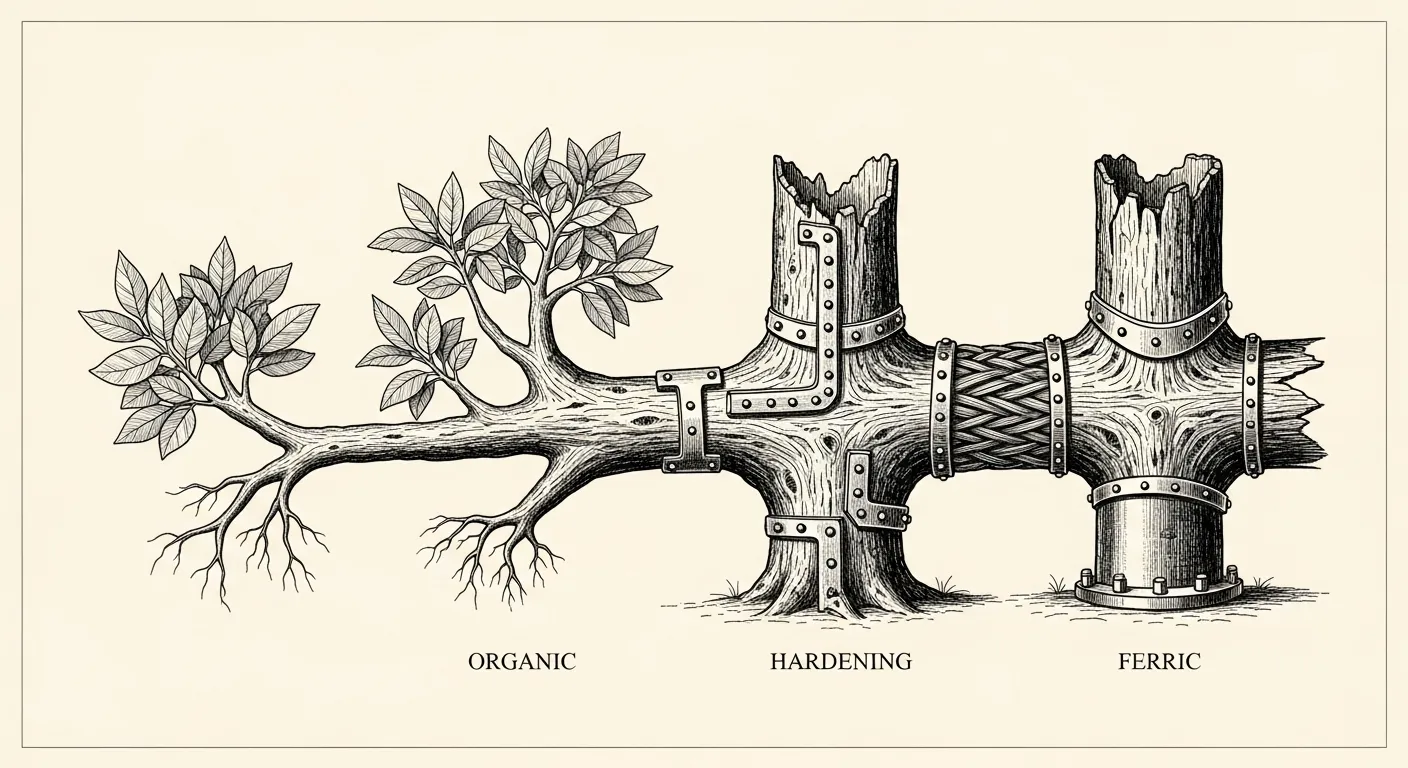
A Python service is a hypothesis you can still edit. A Rust binary is an argument you have stopped having. Every service in Sanctum begins as the first, and a lucky few earn their way into the second — and the only interesting question is when a service is allowed to cross over. The rule is short: organic stuff is Python; once it hardens, it rusts.
Every service starts as a Python script, because Python is what you write while you’re still discovering what the service is. The curfew engine didn’t know it needed credits, or homework mode, or guest approvals, until the first time somebody’s kid found a loophole. Iterating that in Rust — where every schema change costs an hour of borrow-checker yoga — would have meant shipping less, slower, with fewer features your family actually needed.
Once a service stops discovering what it is, the cost function flips. The reward of Python (fast iteration) is moot because nothing is iterating, and the costs (no compile-time guarantees, requirements.txt drift, 400 MB of .venv, a process that silently OOMs at 3 AM) are paid every day. That’s the moment to port to Rust, where the single-binary deploy and launchd-friendly lifecycle pay off forever afterward. What follows is the doctrine for that crossing, and the one-second tool that tells us which service sits where — a sibling in spirit to our broader engineering discipline.
The Lifecycle
Section titled “The Lifecycle” organic ← Python, features │ still evolving ▼ hardening ← velocity slowing │ ▼ ready ← quiet for months, │ port scheduled ▼ porting ← Rust source exists, │ runtime still original ▼ rusted / ← Rust binary built and graduated deployed (services/)Services move left-to-right, usually slowly, and can regress — a dormant service that gets a new feature ticket slides from hardening back to organic, which is fine. The intent is to not rewrite in Rust anything still in motion.
Stage Definitions
Section titled “Stage Definitions”Each stage has a precise, testable definition. No vibes.
| Stage | Criterion | Verdict |
|---|---|---|
organic | ≥ 5 commits touching the main source file in the last 30 days | Keep iterating in Python |
hardening | 1–4 commits in the last 30 days, or activity in the last 90 days | Watch — shape still settling |
ready | 0 commits in the last 30 days and ≤ 2 commits in the last 90 days | Port to sanctum-rs/services/<name>/ |
porting | Rust source exists in sanctum-rs/services/, but the binary is not built (or built-but-stubbed) and the deployed runtime is still the original (Python/Node) | Finish the build + cutover, then graduate |
rusted | Rust binary built, but the deployed runtime is still mixed — a Python sidecar is still in the loop (e.g. tts proxies a Python backend; memory-vault shells out to the Python consolidator) | Working Rust skin over a Python organ — finish the port to graduate |
graduated | Rust binary built and the whole job runs from Rust on the target host | (terminal — precedent) |
skip | Criticality below medium | Stays Python forever — rewrite cost not justified |
The thresholds live in tools/rust_readiness.yaml and are deliberately conservative: “hardening” is the default for anything not firmly in either corner, which is the correct bias — do not rewrite what is still changing.
Graduation Criteria
Section titled “Graduation Criteria”Before a service actually gets ported, it must clear all four:
- Velocity floor. The
readysignal fromrust_readinessmust have held for at least 60 days. One quiet month can be a coincidence; two is a trend. - Criticality justifies the rewrite. Low-criticality scripts (a one-off backup utility, a fun demo) stay in Python. Rust buys reliability, and reliability has a price; spend it where it matters.
- Interface surface is documented. HTTP routes, CLI flags, env vars, on-disk state format — written down before anyone opens a Rust editor. If you can’t describe it, you can’t port it.
- Behavioural parity tests exist. A black-box HTTP/CLI suite the Python version passes today, and the Rust version must pass before it takes the launchd slot.
Precedent — what has actually graduated
Section titled “Precedent — what has actually graduated”Two services are currently serving production traffic from a Rust binary: sanctum-watchdog and sanctum-proxy. Both are recent and both are worth being honest about.
sanctum-watchdog — the Rust implementation was imported into the sanctum-rs workspace on 2026-04-09 (commit 83a376a, “Import Mac Mini Sanctum Rust services” — so the Rust code predated the consolidation). Within four days it absorbed the bandwidth monitor (84027b4) and had its self-health reporting normalised in stack checks (8a0ee66). The live process is the Rust binary — but it ships as sanctumd (the crate at services/sanctum-watchdog/), not a binary literally named sanctum-watchdog. Go looking for a process called sanctum-watchdog and you’ll find nothing; the registry name and the deployed binary name diverge, and that’s the first thing worth knowing.
sanctum-proxy — the cloud-tier model router on :4040, dispatched by the com.sanctum.proxyd LaunchDaemon through ~/.sanctum/bin/proxyd-launch (a wrapper that injects the Gemini/OpenRouter keys before exec). Same name trap: the live binary is proxyd, built from services/sanctum-proxy/. The deployed copy at ~/.sanctum/sanctum-proxy/sanctum-proxy (last touched 2026-04-19) is now an orphan — the runtime execs target/release/proxyd directly, and that directory survives only as the launcher’s working dir and the home of config.yaml.
The crucial observation isn’t a timeline — it’s that both rewrites were boring. No surprises, no redesign, no “while we’re at it” features. If the Rust port is interesting, the service wasn’t ready.
Forward-looking: with Sanctum only weeks old, this doctrine is mostly aspirational. The 30-day and 60-day windows below assume a system mature enough to have 60 days of quiet to point at; most services here don’t yet. That’s a feature — the rules will bite as the codebase ages, which is exactly when you want them to.
The Current Registry
Section titled “The Current Registry”The source of truth is tools/rust_readiness.yaml. As of this writing:
| Service | Language | Criticality | Stage |
|---|---|---|---|
force-flow | Python | critical | hardening |
screen-time | Python | critical | organic |
memory-vault-mcp | Rust (+ Python consolidator) | medium | rusted |
sanctum-watchdog | Rust (sanctumd) | critical | graduated |
sanctum-proxy | Rust (proxyd) | critical | graduated |
sanctum-firewalla | Rust binary / Node runtime | high | porting |
sanctum-tts | Rust adapter / Python runtime | medium | rusted |
To get the live view, run the tool:
python3 tools/rust_readiness.py # pretty tablepython3 tools/rust_readiness.py --json # for the dashboardpython3 tools/rust_readiness.py --strict # exit 1 if any service is "ready" (CI gate)python3 tools/rust_readiness.py --find living-force # resolve an alias to its serviceServices carry aliases in the registry to reconcile doctrine names with runtime names. The Living Force is documented on its own architecture page but runs as the sanctum-watchdog crate (the sanctumd binary) — --find living-force lands exactly there, and the table prints the alias dimly under the service name so the link is visible at a glance.
Tooling
Section titled “Tooling”tools/rust_readiness.py is a single-file Python script with no deps beyond PyYAML. It reads the registry, runs git log against each service’s source path, computes loc, and derives a stage per the YAML policy. Output is an aligned table on a TTY (with stage colours) and JSON otherwise, so dashboards can ingest it directly.
The intention is for this to be:
- Cheap to run — no network calls, only local git and file reads. Takes under a second.
- Cheap to trust — the velocity rule is three comparisons in
derive_stage(); no ML, no heuristic stack, no override magic beyond explicitstage_overridefields. The one bit of cleverness earns its keep: agraduatedoverride is honoured only iftarget/release/<name>actually exists on disk (_graduated_is_real()), so the registry physically cannot print a graduation that hasn’t compiled. A claim the build can veto beats a claim it can’t. - Cheap to wire up —
--strictexits 1 if any service isready, so a nightly cron can page someone when a service quietly finishes cooking.
Future work: surface the table in the Holocron UI, and emit a weekly “language maturity report” into Jocasta’s Monday digest summarising which services moved stages.
Why This Doctrine Exists At All
Section titled “Why This Doctrine Exists At All”Because the most tempting way to lose a weekend is to rewrite a working service in a language you like more. This doctrine is the speed bump between “I have a weekend” and “I have a production outage.” A service still growing limbs isn’t ready; a service that has stopped will pay you back for years if you make it boring and ferric. The trap is “just one more turn” — one more refactor, one more crate, one more abstraction that looks clean in the diff and breaks something invisible on the machine. The harness exists to tell you when the turn is actually free.
Python while the shape still moves. Rust once it stops. Watch the tool.