

You Always Know
Silence is failure. If a critical service is down, the channel itself doesn’t get to be the reason you don’t hear about it. Force Flow is the path; an independent watchdog catches the case where Force Flow itself is what’s down.
On 2026-05-02 the Mini rebooted before a flight. The post-boot self-test ran four minutes after the kernel came up, fired a single Signal alert noting three failing services, and went quiet. Five days and seventeen hours later — Bert in Palo Alto, asking from a hotel room how the reboot had gone — the answer was: the haus had been down the entire time. Home Assistant had been dead. Its gateway had crashlooped silently, waiting on a container that no longer existed. Two Rust services had been crashlooping behind orphan PIDs from boot. Nothing past that one Signal had paged anyone.
The system was “running” in every sense the launchd CLI cared about. It was also, in the sense Bert cared about, not.
The Reliability Doctrine is what came out of the next forty-eight hours.
You Always Know
Silence is failure. If a critical service is down, the channel itself doesn’t get to be the reason you don’t hear about it. Force Flow is the path; an independent watchdog catches the case where Force Flow itself is what’s down.
Self-Heal First; Humans Last
Probes detect, failsafes act, runbooks escalate — in that order, with bounded retries between. Bert’s iMessage is the last move on the ladder, not the first.
No Phantom Alerts
A probe that lies (says HEALTHY while the service is dead) and a probe for a service that no longer exists are the same crime: they teach you to ignore alerts. Both are doctrine violations.
These are the non-negotiables. If a clause anywhere else in the doctrine appears to conflict with a principle, the principle wins; the clause is the bug.
P1. Every always-alive service must be load-bearing. If a service can disappear for a week and no one notices, it doesn’t belong in the always-alive set. Move it to a cron, retire it, or admit you don’t actually need it.
P2. Every always-alive service must satisfy the four-layer pattern. Patch + probe + failsafe + runbook. No exceptions. Merge gate.
P3. Self-heal gets the first move; humans get the last. Probes detect, failsafes act, runbooks escalate. Bounded retries between every transition.
P4. Silence is failure — escalation has a ceiling, not just a floor. A service reported failing once and still failing must escalate again. No “I told you about this five days ago” exemption.
P5. The escalation channel must outlive its primary path. Force Flow is the path. The failsafe-to-iMessage watchdog catches the case where Force Flow is the thing that died. Belt and suspenders are not optional when the suspenders are the alert.
Every always-alive service satisfies all four. A PR introducing a new service must declare its tier and present its four layers; a PR retiring a service must remove the corresponding probe in the same change.
Layer 1 — Patch
The durable upstream fix. Lives in version control, ships with a regression test that fails before and passes after, gets filed upstream when the bug is upstream. // works around X comments without a regression test are debt, not documentation.
Layer 2 — Probe
Liveness, cadence, and a contract assertion. Cadence is tier-proportional: 60s for the haus- and council-critical probes, 5 min for the ops-critical ones, longer for slow canaries that cost real tokens to run. The contract assertion exercises the actual work surface — does the bridge return hosts, does the model serve tokens, does the gateway round-trip a synthetic event. Endpoints that return 200 because the process exists are not probes; they are theater.
Layer 3 — Failsafe
The auto-heal action, with bounded retries and closed-loop verification. Three attempts max, exponential backoff, and the same probe must return HEALTHY before any heal counts. Truthy dict ≠ success. Self-healers that detect-and-only-log are a doctrine violation; the haus stayed down for nearly a week behind one of those.
Layer 4 — Runbook
Both human-readable and machine-executable. The human form is a markdown page in docs/doctrine/runbooks/<service>.md; the doctrine merge gate refuses any new always-alive plist that ships without one. The machine form is the consolidated tools/sanctum-recover umbrella — --list, --dry-run, --json, or a bare run to actually fix — which auto-detects and heals the known break-glass scenarios rather than scattering one .sh per service. Drill each at least once per quarter; a failed drill is a doctrine bug, not a footnote.
Every probe emits one of four states in structured form. Force Flow routes on these:
| State | Meaning | Triggers |
|---|---|---|
HEALTHY | Liveness OK, cadence OK, contract OK | No action |
DRIFT | Liveness OK but readiness or contract divergent | Failsafe (drift correction) |
FAILED | Liveness or contract failing; retries available | Failsafe (auto-heal) |
BLOCKED | Failsafe exhausted, or external dependency wedged | Human escalation per channel grammar |
The state machine is small enough to memorize. HEALTHY ⇄ DRIFT. HEALTHY → FAILED → HEALTHY|BLOCKED. DRIFT → BLOCKED. BLOCKED → human via runbook → HEALTHY.
Severity maps to channel by tier, not by service:
| Severity | Channel | Latency |
|---|---|---|
| P0 | iMessage + Yoda phone call | Minutes |
| P1 | iMessage | Tens of minutes |
| P2 | Signal (held to the log during 23:00–07:00 EDT quiet hours) | Hours |
Heal-then-escalate is the intended shape: try to fix it first, widen the channel only when persistence proves the system can’t fix itself. Today that’s a single flat fuse — the Force Flow failsafe probes every 60s and, after five consecutive failures (~5 min), fires one P0 iMessage directly, bypassing the very path it’s watching. The graduated ladder the doctrine calls for — heal at two minutes, heal again plus a Signal heads-up at five, iMessage and a phone call at ten — is the target, not yet the wiring.
P0 alerts override quiet hours, always. The haus does not wait until morning.
The doctrine isn’t novel — its parts are well-known reliability patterns from SRE practice and military doctrine. What’s specific to Sanctum is the commitment to apply all four layers to every always-alive service, and to treat silence as a failure mode equal in severity to a crash. Where the Resilience Doctrine keeps the haus alive when the grid or the uplink dies, this one keeps the always-alive services honest about whether they’re actually alive.
Without this commitment, what happens is what happened on 2026-04-27: a maintenance window stops a container, no commit retires the service, the post-boot self-test fires one alert at the next reboot, the gateway daemon crashlooooooops politely on the missing container, the self-healer faithfully detects the problem every thirty minutes, and nobody hears anything. Five days later the lights still come on because someone happened to ask.
This doctrine makes that exact failure structurally impossible. The patch is in code; the probe carries a contract assertion; the failsafe actually heals and verifies; the runbook is drilled. And if the channel itself dies, an independent watchdog catches it.
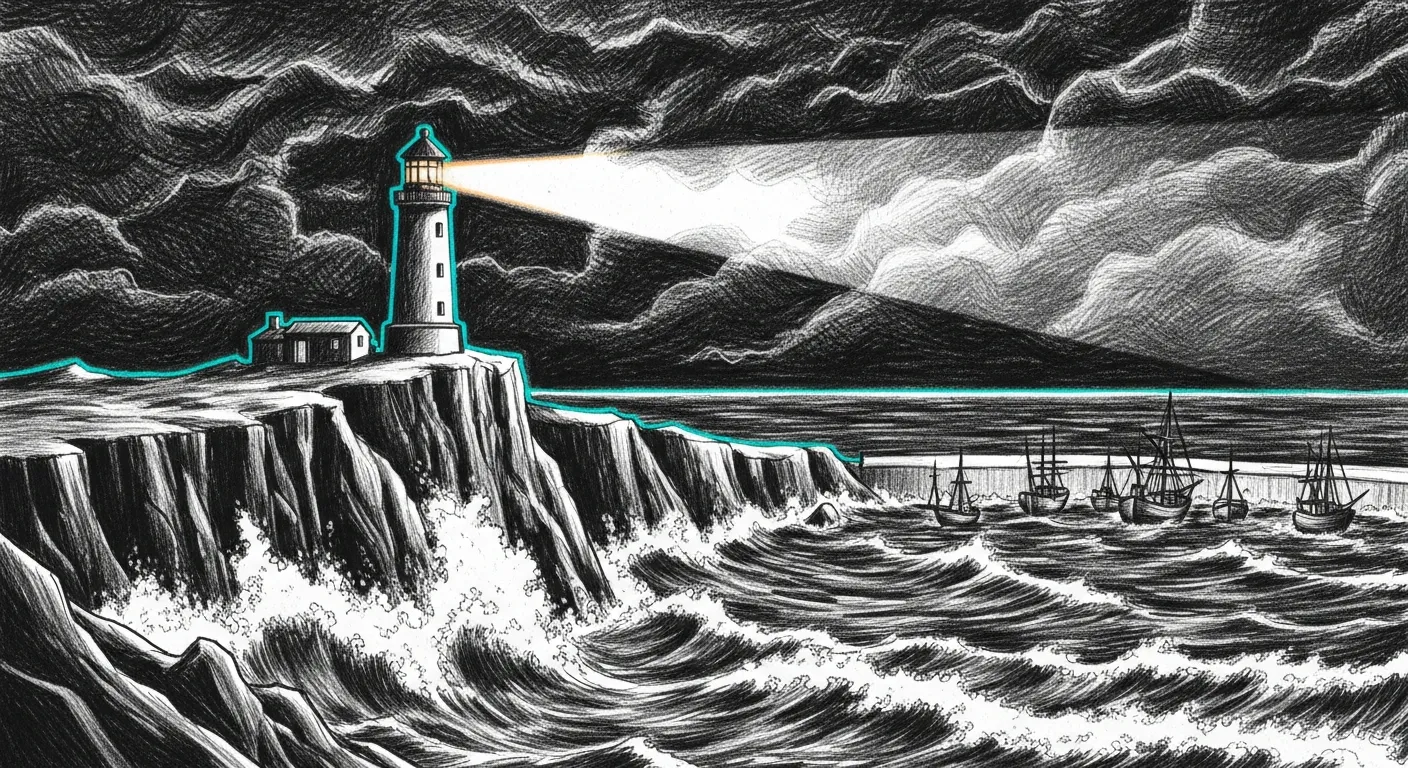
The lighthouse keeper is invisible inside. The light is the only proof anyone is home. Doctrine v1 is the keeper’s standing order: keep the light on, and if you can’t, scream loud enough that someone can.