

Service Graph
The old watchdog was honest and dumb. One list, one idea: check everything, restart whatever’s broken. No context. No depth perception. The emotional intelligence of a while true; do restart; done loop.
When the Ubuntu VM goes down, the flat watchdog dutifully restarts everything that depends on it — a retry storm that accomplishes nothing, because the root is dead and nobody told it to look down. Like calling an ambulance for every room in a haus that lost power. The problem was the breaker, and the watchdog didn’t know breakers existed.
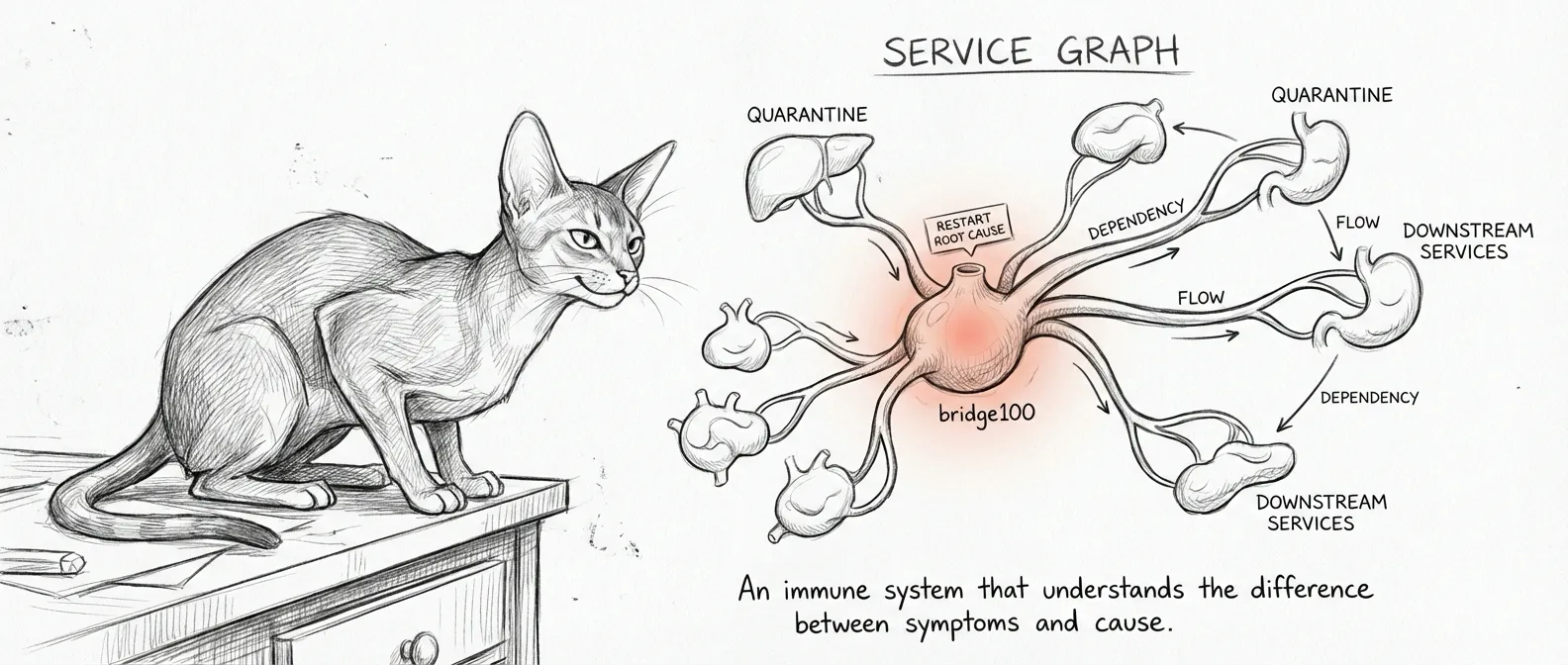
The service graph replaced that flat list with a tree. Thirty-seven services, wired by who-needs-whom. When something breaks, the graph walks upward until it finds the cause, then names that. Everything downstream recovers once the root is back — or doesn’t, in which case you have a different problem and possibly a different hobby.
Service Manifests
Section titled “Service Manifests”Every monitored service gets a YAML file in ~/.sanctum/services/ — one per service, thirty-seven files. Each declares what the service provides, what it requires, how to check its pulse, and how to restart it when the pulse stops: a birth certificate, a résumé, and a DNR order in one.
name: voice-agenthost: mactype: serviceprovides: - voice-agent - port:1138requires: - sanctum-ttshealth: liveness: type: port host: localhost port: 1138 interval: 60remediation: responsible_agent: quigon max_restarts: 3 cooldown: 60 restart_cmd: /Users/neo/.sanctum/scripts/heal_launchagent.sh com.sanctum.yoda-agentThe requires field is where the graph gets its edges — a flat list of names another manifest provides. If voice-agent requires sanctum-tts, then when sanctum-tts is dead the graph won’t waste time restarting the voice agent — it would just die again. Sisyphus on a sixty-second timer.
An empty requires makes a root — it depends on nothing but the machine being on and the laws of physics holding. If either fails, you have bigger problems than YAML can solve.
The Dependency DAG
Section titled “The Dependency DAG”Here’s where it gets beautiful, in the way that only directed acyclic graphs can be: extremely, if you’re reading this page, and invisibly to everyone else in your haushold.
service-graph.py graph reads every manifest, extracts the requires edges, and builds a DAG. Most of the thirty-seven are roots — independent islands. The interesting part is the handful wired up:
sanctum-tts vm health-center graphiti-server├── sonos-bridge ├── orbi-bridge └── health-tunnel └── health-ingester└── voice-agent └── health-tunnel ^ └── (also requires vm)health-tunnel earns the graph its middle initial: it requires both health-center and vm — a join, not a leaf.
Root-cause analysis walks UP. When voice-agent fails, service-graph.py root-cause checks sanctum-tts; if that’s also down, it’s your root cause — one fix, not two. The old watchdog would have filed two complaints and restarted two corpses, one only a symptom.
Topological ordering also gives the graph a restart sequence: you don’t restart a service before its dependencies are alive, the way you don’t serve dinner before turning on the stove. The Force has a direction, root to leaf.
Manifest Validation
Section titled “Manifest Validation”service-graph.py validate asks a simple, uncomfortable question: do the manifests even agree with each other? Right after a fresh edit, usually not — they’ve technically never broken up but haven’t been in the same room for months.
Validation runs four structural checks across all manifests:
| Check | What It Catches |
|---|---|
| Dependency resolution | A requires entry that no other manifest provides — a dangling edge |
| Circular dependency | A cycle in the graph (Kahn’s algorithm); the “acyclic” in DAG is load-bearing |
| Sudo path safety | A restart_cmd invoking sudo somebinary by bare name instead of an absolute path, which won’t match the NOPASSWD sudoers rule |
| Pre-restart steps | A pre_restart hook missing its name or command, or an unknown when clause |
A dangling requires is the most common find — someone renamed what a service provides and forgot the other end of the edge. None are fatal at runtime; all mean someone changed something and didn’t tell the graph.
What validation does not yet do is reconcile manifests against live reality — diffing what they declare against what LaunchAgents run and what ports actually listen, to surface drift, orphans, and ghosts. That cross-check is designed, not built; today the runtime side falls to the narrower drift-sentinel.sh.
Remediation Ladder
Section titled “Remediation Ladder”When a service fails its liveness check, the graph doesn’t panic — panic is for flat lists. service-graph.py remediate <name> works in three deliberate moves.
- Root-cause first — Before touching the failed service,
root-causeasks whether this is the breaker or just a dark room. If a dependency is the real corpse, you remediate that — restarting a service whose foundation is dead just repaints a ceiling over a cracked slab. - Pre-restart, then self-heal — Optional
pre_restartsteps (clear a stale lock, kick a dependency) run conditionally; if they don’t fix it, the graph fires therestart_cmd, waits the startup timeout, and re-probes liveness to confirm the patient woke up. Most failures are transient, and transient failures respond to percussive maintenance. - Budget, then quarantine — Every restart counts against a budget (
max_restarts, default 3) in a rolling window. Exhaust it and the service is quarantined instead of restarted again — the graph stops digging.
What it does not yet do automatically is climb past a single service — cascading a dependency restart, replaying a subtree in topological order, or dispatching the code-forge agent. The DAG already computes the transitive deps and order those rungs need; the engine is built, the escalation isn’t. Past quarantine, the manifest’s responsible_agent names who to page — Qui-Gon for the voice agent above — and a human arrives with hands, judgment, and a glass of something strong.
Crash Loop Quarantine
Section titled “Crash Loop Quarantine”Quarantine isn’t permanent exile — it’s a timeout that gets longer each time. The graph self-releases on an exponential backoff (1h, then 4h, 12h, 24h by tier) and allows one retry with a fresh budget; if that also fails, the timer doubles down and the service goes back in the corner. A human can cut the wait short with service-graph.py unquarantine <name>, which force-releases it and resets the budget and backoff tier — for when you’ve already fixed the corrupted index and you’d like the machine to take your word for it. Bring coffee.
Metrics
Section titled “Metrics”A system that heals itself needs to remember what it healed and whether the patient is getting worse — otherwise you’re not a doctor, you’re a bartender with aspirin.
metrics-collect.sh is designed to run every five minutes, recording per-service RSS (rss_kb), disk usage, load average, and Docker container counts into a SQLite database at ~/.sanctum/metrics/metrics.db. Small footprint, append-only, auto-purged past 30 days. The catch: no LaunchAgent fires it, so the newest row is from April. The script works; the cron around it went missing — an accountant on unannounced sabbatical.
anomaly-detect.py reads that database for two patterns. A threshold anomaly is a service whose current RSS sits more than 2σ above its rolling 24-hour mean — the suddenly-fat process. An RSS leak is subtler: a linear regression on the last 6 hours of rss_kb projecting the service past a fixed 1.5 GB ceiling within 4 hours. Precrime, but for RAM. Both need live data — which loops back to the absent collector.
| Script | Interval | Storage | Purpose |
|---|---|---|---|
metrics-collect.sh | 5 min (designed; agent not installed) | metrics.db (SQLite) | RSS, disk, load, containers |
anomaly-detect.py | per run, against the DB | same | 24h mean + 2σ threshold, 6h leak regression |
The difference between monitoring and surveillance is consent. Your services consented when you wrote their manifests — and skipped the terms, but that’s a problem for robot lawyers.