

Council Router
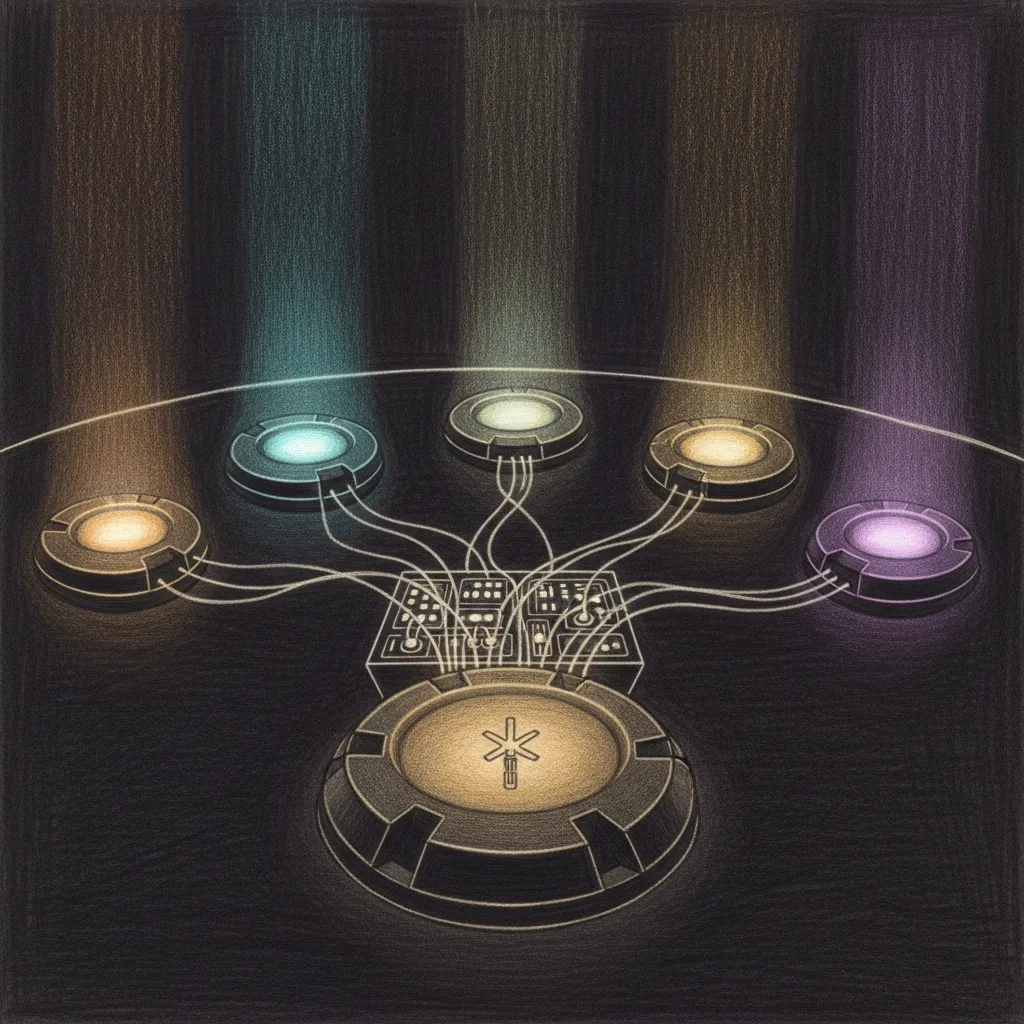
For the first year of the Sanctum Council, agents talked to each other by running SSH one-liners from memory. Windu would discover something at 2 AM, spawn a subshell to ssh neo@10.0.0.1, hope the right PATH was in scope, and fire a message into the void. Half the time it reached the right agent. The other half it reached nothing, your login shell, or an unrelated cron job that was now very confused.
Council Router is the fix. One routing table. One message format. Every node, every agent, every direction — routed, escalated, or logged on purpose.
Topology
Section titled “Topology”The council lives across four nodes, each hosting a subset of agents. Routing is defined in ~/Projects/openclaw-skills/council-router/config/nodes.json.
| Node | Host | SSH User | Agents | Role |
|---|---|---|---|---|
hub (MM64) | 10.10.10.1 | neo | jocasta, codex, claude, gemini | Mac Mini — intelligence, CRM, the bridge between the haus and the world |
vm (Manoir VM) | 10.10.10.10 | ubuntu | yoda, windu, quigon, cilghal, mundi | Ubuntu 24.04 on Lima/vz — the Council proper |
satellite (MM16) | 100.0.0.32 | neo | ahsoka | Chalet Mac — reserved; node offline, Ahsoka not yet deployed |
mobile (MBP128) | 192.0.2.2 | neo | gemini, claude | MacBook Pro, when docked on Thunderbolt |
Each node has a CLI binary (openclaw) and a per-agent flag table: Yoda is invoked as agent --agent main on the VM, Windu as --agent windu, and so on. The router knows all of this, so you don’t have to.
Agents & Domains
Section titled “Agents & Domains”| Agent | Node | Role | Domains |
|---|---|---|---|
| Yoda | vm (main) | Grand Master | Routing, delegation, council sessions, daily digest |
| Jocasta | hub (main) | Intelligence | Email, calendar, CRM, deal flow, Messages archive |
| Windu | vm | Security | Auth logs, Firewalla, Tailscale, intrusion detection, drift sentinel |
| Qui-Gon | vm | Infrastructure | Disk, Lima VM, sanctum-mlx + sanctum-mlx-devstral, gateways, backups |
| Cilghal | vm | Health | Apple Watch, sleep, HRV, activity |
| Mundi | vm | Finance | Fund models, cap tables, portfolio telemetry |
| Ahsoka | satellite | Remote | Chalet network, home automation (phase 3) |
Bert is not in the table. Bert is the escalation target, not an agent.
How Routes Resolve
Section titled “How Routes Resolve”send.sh <from> <to> <type> <priority> <message> │ ├─ Look up <to>'s node in nodes.json ├─ Look up local node (Darwin → hub, Linux → vm) │ ├─ Local node == target node? │ └─ invoke <cli> agent --agent <flag> --message <structured> │ ├─ Direct route exists (hub ↔ vm)? │ └─ ssh <user>@<host> '<cli> agent --agent <flag> --message <structured>' │ └─ Indirect route (satellite ↔ vm, mobile ↔ vm)? └─ relay through hub (see relay_rules)The router never silently invents a path. If the relay rule is missing, the send fails loudly. An agent that thinks it sent a message and didn’t is exactly the kind of silent-failure the council was built to stop.
Message Format
Section titled “Message Format”Every message — whether local, remote, or relayed — carries the same structured header:
[COUNCIL-MSG] from:<agent>@<node> to:<agent>@<node> type:<type> priority:<priority>---<message body>Types: alert, briefing, request, task, response, escalation, session
Priorities: low, normal, high, critical
The receiving agent parses the header first, the body second. This means Yoda can triage “is this urgent?” without reading the prose, which matters when a daily digest contains thirty entries and one of them is on fire.
send.sh — point-to-point
Section titled “send.sh — point-to-point”# Windu tells Yoda about a suspicious login./scripts/send.sh windu yoda alert high \ "Unusual SSH login from 203.0.113.42 targeting neo@10.10.10.1"
# Yoda delegates a ticket to Qui-Gon./scripts/send.sh yoda quigon task normal \ "Docker container 'memory-vault' has been unhealthy for 12 minutes. Investigate and restart if safe."
# Jocasta hands Yoda the morning briefing./scripts/send.sh jocasta yoda briefing normal \ "Morning briefing: 3 unread emails flagged, 2 meetings today, 1 term sheet deadline Friday."broadcast.sh — one-to-many on a node
Section titled “broadcast.sh — one-to-many on a node”# Yoda wakes every agent on the VM./scripts/broadcast.sh yoda vm announcement normal \ "Daily digest at 09:00 — submit your status reports."Broadcast skips the sender if the sender is on the target node. It also keeps a failure count, so a partial broadcast reports which agent refused.
council-session.sh — multi-agent deliberation
Section titled “council-session.sh — multi-agent deliberation”./scripts/council-session.sh "Migrate Docker host to VM?" \ "yoda,windu,quigon" \ "Current Mac host is out of disk. VM has 200G free but no GPU passthrough."Sessions write to ~/.openclaw/workspace/council/sessions/session-<YYYYMMDD-HHMMSS>.md — the topic lives in the file’s header, not its name, so two debates about the same question never clobber each other. Each participant reads every prior contribution, adds theirs, and Yoda synthesises the final recommendation. The transcript survives reboots. The agents do not.
health-check.sh — is anyone home?
Section titled “health-check.sh — is anyone home?”./scripts/health-check.sh # human output./scripts/health-check.sh --json # machine outputReturns per-node SSH: OK/UNREACHABLE plus CLI: OK/MISSING, and per-agent AVAILABLE/UNAVAILABLE. It’s a reachability check, not a séance: AVAILABLE means the node answers SSH and the CLI binary is on disk, not that the agent answered. It’s the first thing any other script runs before trusting a route.
Escalation Protocol
Section titled “Escalation Protocol”Escalation levels live in config/escalation.json. Every council-originated message carries a level; the router enforces what happens at each tier.
| Level | Name | Agent Action | Bert Gets |
|---|---|---|---|
| 0 | INFO | Log only | Nothing |
| 1 | ADVISORY | Log + queue for Yoda’s daily digest | Next morning briefing |
| 2 | ATTENTION | Notify Yoda immediately | Signal (batched, max 6/day) |
| 3 | URGENT | Notify Yoda immediately | Signal immediately |
| 4 | CRITICAL | Notify Yoda + voice call | LiveKit call from Yoda |
Quiet hours are 22:00–08:00 America/Montreal. Level 3 and above bypass them. Level 4 bypasses the daily Signal cap, quiet hours, and any notion of restraint.
Cost Control
Section titled “Cost Control”Not every council call is worth an Opus invocation.
| Tier | Model | Who routes here |
|---|---|---|
| Free / local ops | Devstral-Small-2-24B-Instruct-2512-4bit on sanctum-mlx-devstral :3301 (native MLX seat) | Qui-Gon, Ahsoka, coding sub-tasks |
| Free / local secure | Qwen3.6-35B-A3B-4bit on sanctum-mlx :1337 | Cilghal, Mundi (private data stays local) |
| Cloud | Opus 4.8 (claude-opus-4, best subscription) via sanctum-cloud-proxy :4040; cathedral fallback, never metered OpenRouter | Windu, Jocasta, Yoda digest |
| Smart-routed | council-brain (Jocasta, Mon Mothma) and council-max-thinking (Yoda, Mundi) on :4040 | council-max-thinking rides Opus 4.8; council-brain stays local on the cathedral (qwen3.6-35b-a3b-4bit) — no OpenRouter spill |
The router doesn’t pick the tier; the receiving agent does. But because the router carries the from/to/type/priority header, the agent’s model-selection logic has everything it needs to refuse Opus for a level-0 briefing. The target is ~10-15 Opus calls per day across the whole council. Most days it holds.
Integration Points
Section titled “Integration Points”Force Flow
Section titled “Force Flow”Council-originated alerts to Bert go through Force Flow on port 4077 — they don’t fire Signal directly. That way dedup, rate limiting, and quiet hours are decided in one place, not five. Council Router answers “who needs this?”; Force Flow answers “does Bert need to hear about it now?“
sanctum-cloud-proxy
Section titled “sanctum-cloud-proxy”When Yoda synthesises a council session or drafts a daily digest, the model call goes through sanctum-cloud-proxy at :4040. Cost caps, fallback chains, and structured prompts all live there — the router’s job ends the moment the message is delivered to the CLI.
Kitchen Loop
Section titled “Kitchen Loop”The Kitchen Loop uses the router to fan out its six-phase cycle to the appropriate agent in each phase. A phase that can’t reach its assigned agent halts the loop rather than silently skipping — same doctrine as everywhere else in Sanctum.
Tech Lookout & Model Scout
Section titled “Tech Lookout & Model Scout”Model Scout finds a candidate model, writes a report to Memory Vault, and hands Qui-Gon a request/normal via send.sh. Qui-Gon reads the report, convenes a short council session if the decision is structural, or replies with an adoption verdict if it isn’t. The router is the connective tissue — nothing more, but nothing less.
Daily Test Suite
Section titled “Daily Test Suite”Forty-odd tests across six suites — Windu security, Qui-Gon infra, cross-node, system-health, HA-integration, and Qui-Gon resilience — run at 05:00 America/Montreal off a crontab entry (--suite all --quiet). The VM mirror runs the same suite. Results are reported back to Yoda via send.sh, closing the loop on the thing that routes them.
# Run everything with self-healing remediation./tests/run-suite.sh --suite all --remediate
# Run just one suite, quietly./tests/run-suite.sh --suite quigon --remediate --quiet
Self-Healing Remediation
Section titled “Self-Healing Remediation”When --remediate is set, a failure walks three tiers:
Test fails │ ├─ Tier 1: deterministic script auto-fix (restart service, pull model) │ fast, zero LLM cost │ ├─ Tier 2: rerun the failed test to confirm the fix landed │ └─ Tier 3: if still broken (or no auto-fix exists), fire-and-forget a task to Windu or Qui-Gon via send.sh for LLM investigationRemediation is opt-in (--remediate); the scheduled 05:00 run reports without auto-fixing. When you do pass the flag, nine tests have deterministic auto-fixes today: expected services, OrbStack container health, LM Studio models, log-file size, Signal-proxy health, skill-sync freshness, Tailscale status, Signal delivery, and the Council MLX server. The security-class tests — SSH hardening, auth-log anomalies, listening-port audits, and their kin — skip straight to agent escalation, because there is no correct script-only answer for “there is a new SSH key in authorized_keys.”
Escalated investigations run on the native MLX seat sanctum-mlx (Qwen3.6-35B-A3B-4bit on :1337) locally, so the remediation layer itself has no marginal API cost.
Legacy: Council Bridge
Section titled “Legacy: Council Bridge”The older council-bridge skill still works for direct Jocasta ↔ Yoda SSH messages. It’s the one thing Council Router inherits, not replaces — a minimum-viable cross-gateway send that predates the routing table. New code uses the router; old scripts that still call send-to-yoda and send-to-jocasta haven’t been rewritten because they haven’t broken.
If they break, they’ll be rewritten.
Service Details
Section titled “Service Details”| Property | Value |
|---|---|
| Skill path | ~/Projects/openclaw-skills/council-router/ |
| Nodes config | config/nodes.json |
| Escalation config | config/escalation.json |
| Routes config | config/routes.json |
| Scripts | scripts/send.sh, broadcast.sh, council-session.sh, health-check.sh, sentry-check.sh |
| Tests | tests/run-suite.sh (~48 tests across six suites: windu / quigon / cross-node / system-health / ha / resilience) |
| Session workspace | ~/.openclaw/workspace/council/sessions/ |
| CLI (Mac) | ~/Library/pnpm/openclaw |
| CLI (VM) | /home/ubuntu/.npm-global/bin/openclaw |
| CLI (Satellite) | openclaw on $PATH |
The skill is platform-dual: darwin and linux, by design. A macOS shim that tries to run on Linux will route as vm and then fail to find its own CLI, which is the router telling you it noticed.