

(Neuro)diversity is Paramount
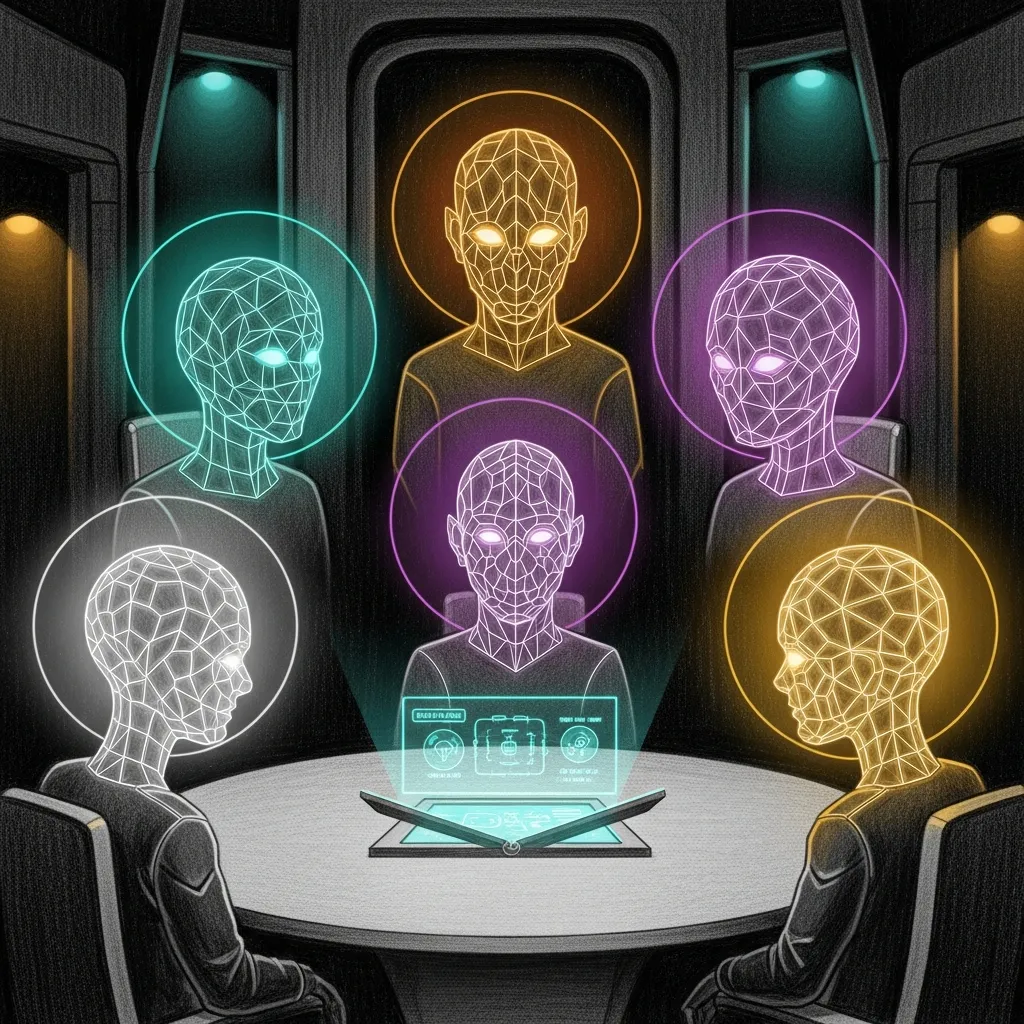
For most of the Council’s life, the five Jedi shared one mind. They had distinct personas — Yoda’s measured cadence, Qui-Gon’s pragmatic flow, Windu’s perimeter-first crispness, Cilghal’s calm clinical precision, Mundi’s fund-manager economy of words — and behind every one of those voices sat exactly one model. Asking the Council for a second opinion was asking the same model to roleplay four different opinions of itself, which is approximately as adversarial as asking a mirror.
Date: 2026-04-28 · Status: Doctrine
This is the doctrine that ended that. (Neuro)diversity is Paramount. Every seat runs a different model family, with different training data, different blind spots, and different ways of being wrong. We chose this on purpose. The cost — operational complexity, four upstream APIs to monitor, four sets of latency tails — is the price of getting answers that aren’t four flavors of the same answer.
The bug under the bug
Section titled “The bug under the bug”The discovery wasn’t planned. While debugging mlx-lm #1185, we asked the Council to validate a fix design. All four Jedi agreed the cap-bound fix was sound. The fix turned out to be wrong. The Council had not detected the wrongness because every voice was a different prompt to the same Qwen3.6-35B-A3B backbone. They shared not just architecture but exact weights. Asking them to disagree was asking a single model to argue with itself, politely.
A second-opinion layer that always agrees is not a second-opinion layer. It is a feedback loop with extra steps.
What changed
Section titled “What changed”The five reasoning seats route to four distinct model families. The current assignment is rendered live from src/data/council-roster.json, regenerated from the Mini’s openclaw.json + sanctum-proxy/config.yaml whenever the lineup shifts:
| Agent | Logical model | Provider | Resolved model |
|---|---|---|---|
| Yoda | council-tiered/council-max-thinking | Claude Max bridge (local) | claude-fable-5 |
| Ki-Adi-Mundi | council-tiered/council-finance | Local | grok-4.5 |
| Qui-Gon | council-tiered/council-code | sanctum-mlx-devstral (local, mTLS) | Devstral-Small-2-24B-Instruct-2512-4bit |
| Windu | council-tiered/council-spacial | Local | gemini-3.1-pro-preview |
| Cilghal | council-tiered/council-heretic | Local | qwen3.6-27b-4bit-champion-ablated |
| Jocasta | council-crm | sanctum-mlx (local, mTLS) | qwen3.6-27b-4bit |
| Mon Mothma | council-brain | Claude Max bridge (local) | claude-opus-5 |
openclaw.json + sanctum-proxy/config.yaml at 2026-08-09T22:23:46Z. Every Jedi falls back to the
local Qwen tier if their primary path fails. Refresh via pnpm refresh:council.
This page is the doctrine. The Council page is the single source-of-truth for the roster — the same component renders there and anywhere else in the docs that needs to say “who runs on what.” When a champion changes (new Claude model, local-tier upgrade, training run promoted), run pnpm refresh:council once and every page reflects the new assignment on the next deploy. No prose to hunt down, no tables to keep in sync.
Fallback for every Jedi is the local Qwen3.6 backend (visible in the per-agent JSON, omitted from the table above for compactness). Cloud paths can fail; the local model is always there, on the loopback, behind the same mTLS we use for everything else.
What this gets you
Section titled “What this gets you”Distinct failure modes. When the Anthropic seat, the Google seat, the French code model, and the local Qwen all reach the same answer, that’s signal — four different architectures failed in four different directions and converged anyway. When they disagree, that’s also signal — the disagreement is the data. The old Council, being one model in four masks, could only ever return the first signal, and it returned it falsely.
Cost discipline. Yoda and Mundi route through the Claude Max subscription, not the metered Anthropic API. The bridge at <MINI>:3456 translates OpenAI-format chat completions into the Max session protocol. Routine Council questions consume zero API credits. Bring-out-the-good-china reasoning happens for the price of the monthly subscription, not per-token.
Privacy by destination. Cilghal’s health workflow never leaves the haus. The data goes to a model running behind certificates the haus signed, on a port that doesn’t accept plain HTTP, on hardware in a basement in Québec. Whatever Apple Health or Withings put in our hands is not on the network of any company we don’t already pay.
What stays the same
Section titled “What stays the same”The personas don’t change. Yoda is still Yoda — the doctrine, the cadence, the SOUL.md. Cilghal still files her morning briefing with the same dry observations. Qui-Gon still notices the things you’d rather he didn’t notice about your kubelet. The model is the engine; the persona is the driver.
The interfaces don’t change either. openclaw agent --agent main --message "…" still works. The Signal channel still works. Home Assistant still triggers Cilghal at 8 AM. Existing integrations didn’t notice the swap, which is exactly the point.
How to verify
Section titled “How to verify”~/Documents/Claude_Code/tools/test-council-routing.shThe script SSH-chains to the VM, invokes each agent, parses the embedded execution trace for the resolved model, and asserts each Jedi reached their assigned model. Five passes means the Council is heterogeneous and routing is healthy. One fail means a backend is down, a key has expired, or a config has drifted — and the script tells you which.
Why the parenthetical
Section titled “Why the parenthetical”The principle is (Neuro)diversity is Paramount — the parenthetical does double duty on purpose.
The outer reading is diversity in the AI sense: distinct architectures, distinct training data, distinct failure modes, distinct ways of being wrong. Different brains in the seats means a real disagreement is possible, which is why a Council exists at all.
The inner reading is neurodiversity in the human sense. The owner of this haus is neurodivergent — ADHD, dyslexia, ASD markers — and Cilghal’s whole domain (see Agent Roles & The Council) is built around scaffolding for that cognitive profile. The same principle that says “different model families think differently” says “different humans think differently.” A system designed to support a neurodivergent operator and only return one kind of answer fails at both ends — it is not actually a Council, and it is not actually accommodating. Diversity at the model layer mirrors and serves the diversity at the user layer.
The principle, plainly
Section titled “The principle, plainly”A council that always agrees is not a council. It is one mind in five chairs.
Every system in Sanctum that asks for a second opinion — the Smart Router’s escalation tier, the eval harness’s adversarial check, the Living Force’s incident review committee — should ask it of someone with a different brain. We built the haus to disagree with us when we are wrong. It cannot do that if every voice in the haus is a copy of the same voice.
Pluralism is operational. (Neuro)diversity is paramount.
See also
Section titled “See also”- Polarity — the underlying principle. This page is its Council-specific application.
- The Smart Router — the routing-tier mechanics that make this work
- Council Router — universal multi-agent message routing
- The Jedi Council — the agents themselves, by domain
- Engineering Discipline — why every claim above is backed by a test