

Polarity
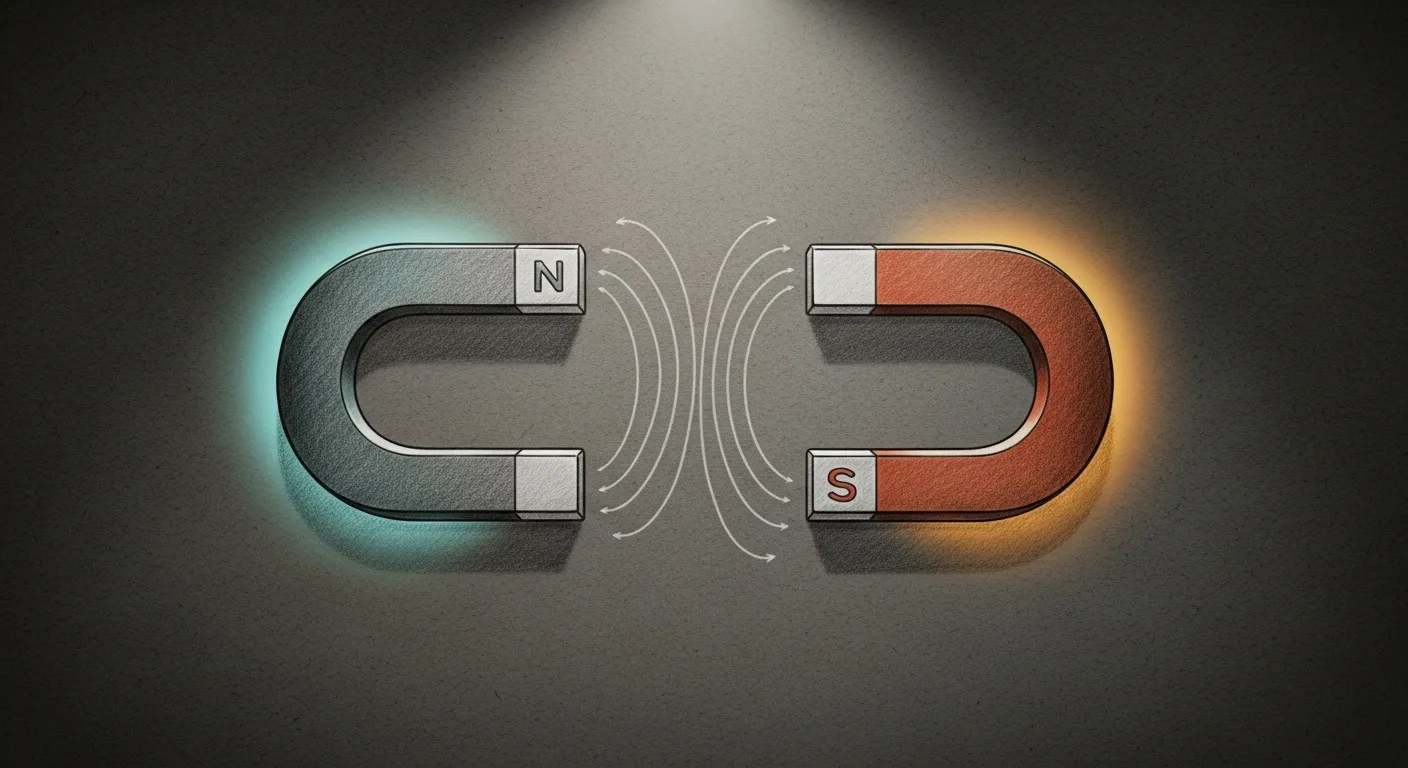
The Jedi Council once voted unanimously to ship a fix. It was the wrong fix. Seven council seats, one verdict, no dissent — and the reason there was no dissent is that all seven were the same model wearing different robes. A council of one cannot disagree with itself. It can only agree, faster and more confidently, all the way off the cliff.
That is the failure this page exists to prevent. Every load-bearing layer of Sanctum runs paired against its complement. Not redundancy — opposition. A single homogeneous voice is a feedback loop in formal wear, and Sanctum’s reliability comes from refusing to ship one of anything that matters.
The principle
Section titled “The principle”Two opposites pull a system into balance. One centered force pulls it into orbit. A backup with one destination cannot be challenged when it lies. A cloud strategy with one vendor inherits that vendor’s outage as its own. Wherever the cost of a silent failure is high, the cure is a counter-force — chosen on purpose, with different failure modes — running at the same time.
This is the same lesson as (Neuro)diversity is Paramount, generalized past the Council. The Council taught us the lesson the expensive way; Polarity is the rule we extracted so nothing else has to learn it twice.
Where Polarity is wired in
Section titled “Where Polarity is wired in”The pattern repeats in every load-bearing layer of the haus. Each row pairs a thing against its opposite — not a copy of itself, but something that fails differently, so one half stays standing when the other falls.
| Layer | Polarity | Why it’s not redundancy |
|---|---|---|
| Council (7 seats) | Four distinct model families — Claude Opus, Codestral, Gemini Pro, sanctum-mlx (Qwen3.6) — agreeing only by triangulation | Same model arguing with itself produces consensus, not signal |
| Backups (restic) | Local T9 SSD + Google Drive cloud — dual-repo, same encryption key | Local-only loses everything to fire; cloud-only loses everything to a credential leak |
| Cloud LLM stack | Claude (Anthropic) + Gemini (Google) | A provider outage shouldn’t take the haus offline; a provider rate-cap shouldn’t either |
| Hosts | MBP for dev/validation + Mini for production | Dev work in prod is how surgical edits become outages |
| Bridge auth | CF Access (edge, service token) + HMAC-SHA256 (origin, per-module) | A leaked CF token alone can’t post; a leaked HMAC alone can’t even reach the bridge |
| Bridge ops loop | Rotator (changes the token) + Canary (verifies the bridge still serves) | The thing that swaps creds and the thing that verifies don’t share a code path or a fault |
| Network egress | Bell-bridged uplink + Firewalla-routed LAN | One controls the wire to the world; the other controls who gets to use it |
| Sanctum-mlx serving | Local Qwen3.6 (mTLS, in-haus) + cloud fallbacks (any Jedi) | Health and family data never leave the haus; everything else can ride the cheaper path |
The cost of running both is real. The cost of running only one is paid later, in events that would have been caught if the other half had been alive at the same time.
When Polarity got skipped — and what it cost
Section titled “When Polarity got skipped — and what it cost”The Council bug under mlx-lm #1185 is the canonical example. The Jedi voted unanimously on a fix that turned out wrong, because every seat was the same Qwen3.6-35B-A3B backbone in a different costume. The fix shipped, the bug got worse, and the second-opinion layer that was supposed to catch it had been a mirror the whole time. That incident is told in full on (Neuro)diversity is Paramount; the lesson it left is this page.
The same shape shows up anywhere we can’t articulate the opposite force:
- iCloud-only backup, pre-2026-04-26. Restic dual-repo (T9 + gdrive) replaced a single-destination iCloud sync that had been quietly producing fresh full copies for months. No verifier, no second destination, no signal — until the SSD went 96 % full and the silence finally made a noise. The fix wasn’t a smarter backup. It was a paired one.
- Single-key SOPS recovery, pre-1Password backup. The age key on disk was the only path to the encrypted secrets. A disk failure plus a missed restic run would have left the haus locked out of itself. The fix added 1Password as the opposite pole — different storage medium, different access path, same plaintext recoverable from either. The full arrangement lives on The Secrets Trifecta.
Both fixes look like “we added a backup.” They aren’t. They added an opposing path, so the failure of one becomes visible to the other.
The Polarity test
Section titled “The Polarity test”Before any new load-bearing piece ships, ask three questions in order:
- What is the opposite force? The thing whose existence makes this one’s silent failure observable.
- Does it live now? Not “could exist” — does it run today, on a different code path, different credentials, different fault domain.
- If the primary fails silently, what notices? Name the specific signal — a status file, a log line, a metric — and which alarm it lights.
If any answer is “we’ll add it later,” the layer isn’t ready to be load-bearing. The opposite ships with the primary, or the primary stays behind.
What Polarity is not
Section titled “What Polarity is not”- Not active-active redundancy. Two restic repos with identical content are complementary destinations, not parallel writers. Two LLMs voting on the same prompt are different perspectives, not failover.
- Not “just add a second one of the same thing.” Two of the same model is one model with twice the bill. Two of the same provider is one outage with one logo on it. The point is the difference in failure modes, not the count.
- Not symmetric. Polarity often pairs a cheap-but-noisy thing against an expensive-but-quiet one — canary vs. real upload, cloud Qwen vs. in-haus mTLS Qwen. The quiet pole is still doing the work the whole time. You just don’t notice it until the day it isn’t.
Doctrine
Section titled “Doctrine”Polarity has been doctrine since 2026-04-30. The (Neuro)diversity Paramount page is the Council-specific application; this page is the principle underneath it, and it feeds the broader Resilience Doctrine. Every new load-bearing addition to Sanctum references this page in its PR description and passes the Polarity test before merge.
The Council still votes. But now it argues first — because a haus that never disagrees with itself is a haus that has already agreed to be wrong together.