

AI Agent System
Somewhere around the third agent, this stopped being a haus automation project. It became a personnel management problem. Sanctum runs a multi-agent AI system split across two platforms — five specialized agents on the VM, one on the Mac — each with a defined role, shared skills, and the quiet confidence of software that doesn’t know it’s running on consumer hardware in a basement.
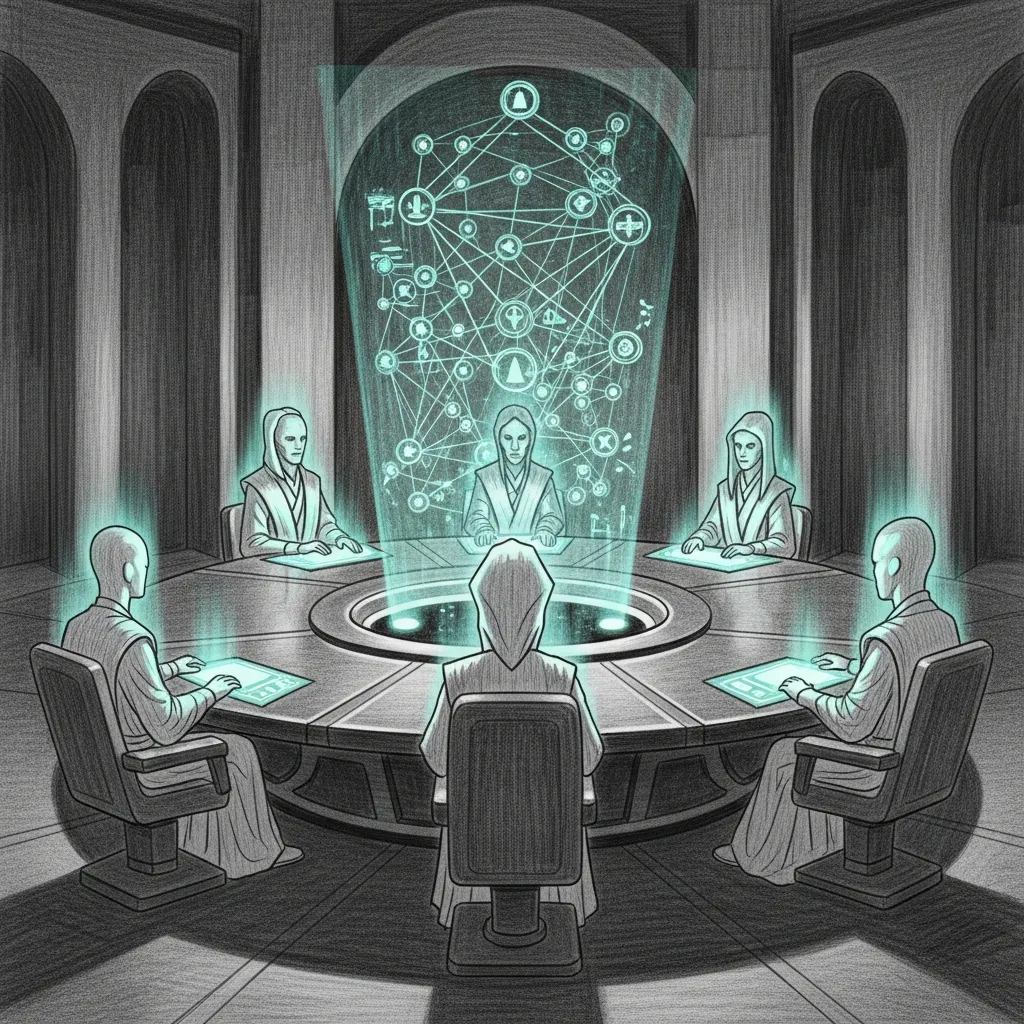
Agent Roster
Section titled “Agent Roster”VM Agents
Section titled “VM Agents”The VM hosts five agents. Yes, five. Each is named after a Star Wars Jedi, because if you’re going to build a council of AI minds inside a Mac Mini, you might as well commit to the bit.
| Agent | Role | Responsibilities |
|---|---|---|
| Yoda | Main | General intelligence, coordination, primary user interface |
| Windu | Security | Network monitoring, threat assessment, security briefings |
| Qui-Gon | Efficiency | Resource optimization, automation suggestions, cost analysis |
| Cilghal | Health | Wearable and scale data, trend detection, daily health briefings |
| Mundi | Finance | Financial tracking, budget analysis, investment monitoring |
All VM agents run through the OpenClaw gateway as a systemd user service. The gateway manages agent lifecycle, message routing, and plugin access. It is, effectively, the Jedi Temple — if the Jedi Temple ran on 12 gigs of RAM and needed its secrets decrypted from a YAML file.
Mac Agent
Section titled “Mac Agent”| Agent | Role | Responsibilities |
|---|---|---|
| Jocasta | CRM | Contact management, relationship intelligence |
Jocasta runs through the DenchClaw gateway on the Mac (the ~/.openclaw-dench/ profile, gateway port 19001, token auth, LAN-bound) with direct access to Mac-native services and the Affinity CRM integration. She is named after the Jedi archivist. Someone has to remember everyone’s birthday.
Model Configuration
Section titled “Model Configuration”Agents use a tiered model strategy with automatic fallback to maintain availability during outages or rate limits. The philosophy: if one brain goes dark, there’s always a dumber one willing to try.
Tiered Model Strategy
Section titled “Tiered Model Strategy”Each agent is assigned a logical tier that resolves to a primary model and a fallback chain. All routing goes through the Sanctum Proxy on port 4040, which reads ~/.sanctum/sanctum-proxy/config.yaml for the resolution.
The mapping below is generated from the live Mini config — not hand-maintained here, because champion models swap often enough that a typed table is wrong within the week. One JSON file owns the truth; every page that shows the roster reads from it.
| Agent | Logical tier | Resolved primary | Fallback chain |
|---|---|---|---|
| Yoda | council-tiered/council-max-thinking | claude-fable-5 (Claude Max bridge (local)) | Qwen3.6-35B-A3B-4bit-text |
| Ki-Adi-Mundi | council-tiered/council-finance | grok-4.5 (Local) | Qwen3.6-35B-A3B-4bit-text |
| Qui-Gon | council-tiered/council-code | Devstral-Small-2-24B-Instruct-2512-4bit (sanctum-mlx-devstral (local, mTLS)) | Qwen3.6-35B-A3B-4bit-text |
| Windu | council-tiered/council-spacial | gemini-3.1-pro-preview (Local) | Qwen3.6-35B-A3B-4bit-text |
| Cilghal | council-tiered/council-heretic | qwen3.6-27b-4bit-champion-ablated (Local) | Qwen3.6-35B-A3B-4bit-text |
| Jocasta | council-crm | qwen3.6-27b-4bit (sanctum-mlx (local, mTLS)) | — |
| Mon Mothma | council-brain | claude-opus-5 (Claude Max bridge (local)) | — |
openclaw.json + sanctum-proxy/config.yaml at 2026-08-09T22:23:46Z. Every Jedi falls back to the
local Qwen tier if their primary path fails. Refresh via pnpm refresh:council.
The constant across every row is the last fallback: when the cloud is rate-limited or dark, each Jedi cascades down to the local Qwen tier and keeps answering. The chain exists so the lights stay on even when OpenRouter is having a day.
Local Models
Section titled “Local Models”| Model | Port | Use Case |
|---|---|---|
| Devstral-Small-2-24B-Instruct-2512-4bit | 3301 (sanctum-mlx) | Local coding tier (council-code) |
| Qwen 3.6 35B (A3B) 4-bit | 1337 (sanctum-mlx, mTLS) | Local council brain — primary and last-resort fallback |
Both are served by the sanctum-mlx cathedral binary (sanctum-rs-cathedral), not LM Studio. The council brain on :1337 is mTLS-only; a pair of socat tunnels re-expose it as plaintext loopback :1339 for the proxy and the vmnet bridge, so the config’s council-mlx/council-27b/council-heartbeat lanes all point at :1339 and land on the same process — Qwen3.6-35B primary, plus a Qwen3.6-27B-4bit secondary via dual-residency.
council-code is intentionally not a prompt trick. The proxy owns that routing decision. When the request is clearly about code, tests, shell, or config surgery, the infrastructure routes it to Devstral on :3301 and logs the handoff like any other policy decision.
The current local serving split, once you stop lying to yourself about it:
:3301is Devstral-Small-2-24B — the coding specialist (council-code).:1337(mTLS) /:1339(plaintext viasocat) is Qwen3.6-35B — the local council brain and everyone’s final fallback.
One model for code, one for everything else. LM Studio and the old :1234 lane are retired; the socat bridge that fronted it went with them (retired 2026-06-07), so nothing answers on :1234 at all. Fewer onions.
Sanctum Proxy
Section titled “Sanctum Proxy”The Sanctum Proxy is the primary routing layer for all agent model requests. It is a single Rust binary on port 4040 that handles request sanitization, content-based routing, prompt caching, assistant prefill stripping, model resolution, fallback routing, PII scrubbing, and analytics.
See the Services page for the full 7-step request pipeline.
Gateway Architecture
Section titled “Gateway Architecture”Each platform runs its own gateway instance:
| Platform | Gateway | Port | Bind | Config Location |
|---|---|---|---|---|
| Mac | DenchClaw | 19001 | LAN | ~/.openclaw-dench/ |
| VM | OpenClaw | 1977 | LAN | ~/.openclaw/ |
The VM gateway runs as a systemd user service with linger enabled, starting automatically at boot. It uses a SOPS wrapper script to decrypt secrets before launch. Its 1977 is forwarded to the Mac over the lima port-bridge, so a curl to 127.0.0.1:1977 on the Mac actually reaches the VM gateway — a detail that has fooled at least one incident investigation into thinking it was a Mac-native service.
Both gateways run the same OpenClaw codebase with independent configurations. Two embassies, one language.
Council Bridge
Section titled “Council Bridge”The Council Bridge enables communication between Jocasta (Mac) and Yoda (VM). Since gateways block plaintext WebSocket connections to non-loopback IPs, all cross-instance communication routes through SSH. Because nothing says “cutting-edge AI” like shelling out to a protocol from 1995.
Mac to VM
Section titled “Mac to VM”Jocasta → SSH to ubuntu@10.10.10.10 → openclaw agent --agent main --message "..."VM to Mac
Section titled “VM to Mac”Yoda → SSH to neo@10.10.10.1 → PATH=<node path> openclaw agent --agent main --message "..."The bridge skill maintains a heartbeat every 2 hours to confirm bidirectional connectivity. If the heartbeat fails, an alert is raised through the watchdog system. Silence is itself a signal.
Plugins
Section titled “Plugins”Agents have access to shared plugins that extend their capabilities:
| Plugin | Status | Description |
|---|---|---|
| Neo4j KG | live | Knowledge graph via Graphiti on :31416 (VM-side python, backed by a Neo4j container) |
| memory-core | disabled | In-gateway persistent memory; currently enabled: false — cross-session state lives in the Memory Vault instead |
Plugins are configured at the gateway level and available to all agents on that gateway instance. The gateway’s own memory-core is off; the persistence agents actually use is the markdown Memory Vault on the Mini, synced over SSH — which is a fancy way of saying the council leaves each other notes.
Skills System
Section titled “Skills System”Agents access executable skills from the shared skills repository. Skills provide domain-specific tools that agents can invoke during conversations. See the Skills Development guide for details on the skill system architecture.
Skills are loaded from:
- The built-in skills directory in the OpenClaw installation
- Extra skills directories configured in
openclaw.json(pointing to~/Projects/openclaw-skills)
Holocron Interface
Section titled “Holocron Interface”The Holocron is the family-facing surface — the part of this system that doesn’t require a terminal. It is now a signed and notarized native macOS app (The Holocron.app, bundle ID com.manoir.the-holocron), not a web page. See Holocron App for the build, signing, and renderer-hardening workflow.
The DenchClaw gateway also ships a browser chat profile at ~/.openclaw-dench/ (gateway :19001, token auth, LAN-bound, allowed origins holocron / holocron.local). It’s the legacy web path: configured, but not the live interface and not currently listening. If you find yourself curl-ing http://holocron/ and getting nothing, that’s why — the family uses the app now.
The point of either surface is the same: let haushold members interact with the agent system without needing direct gateway access. Because explaining SSH to your family is a different kind of support ticket.