

Category map
Domain → service → group classification. Suffix-matched on dotted
boundaries; longer matches win. m.youtube.com and
r2---sn-n4v7.googlevideo.com both resolve to youtube, which rolls
up to video_streaming.
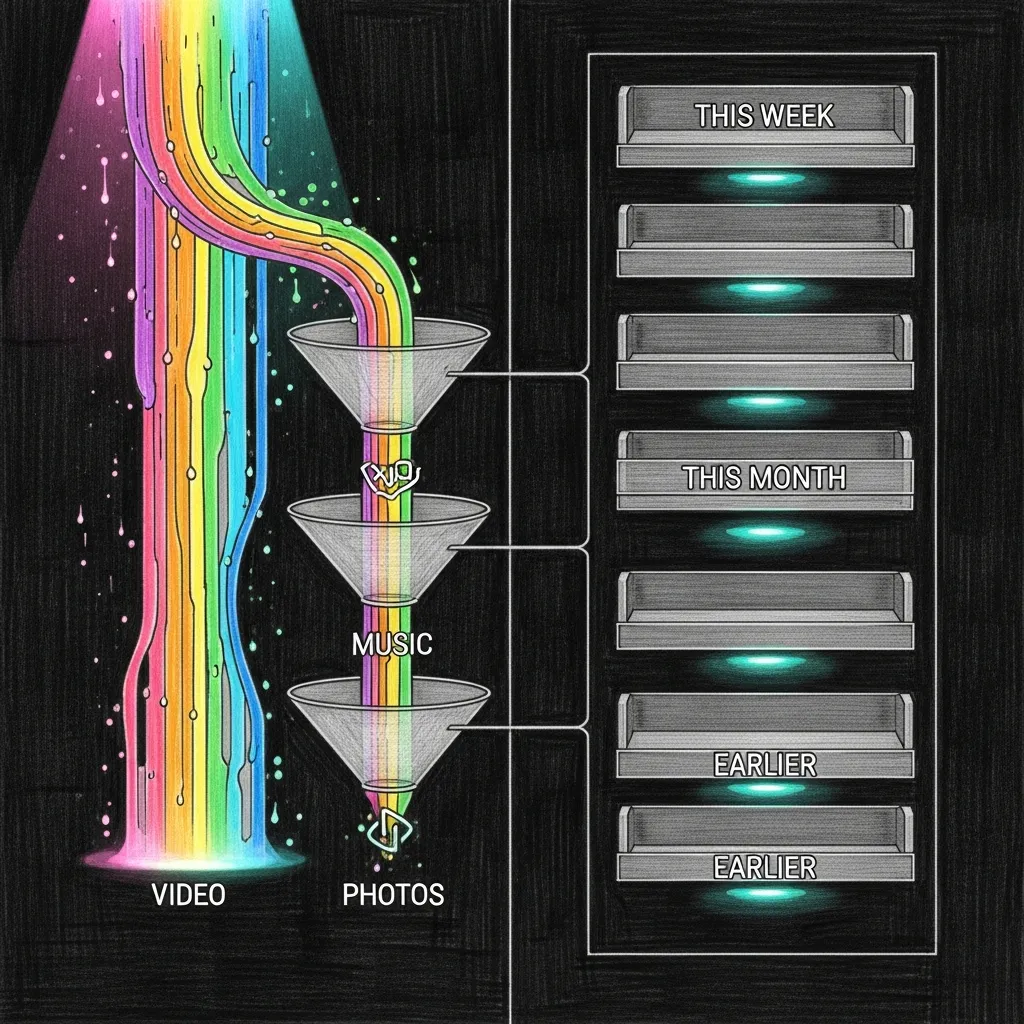
Albert had Crunchyroll on the TV and Fortnite on his phone at the same time. The old screen-time stack could tell you he’d been on the network for four hours — never what he’d been doing for four hours. That is half of a screen-time system. Force Flow now has the other half, and its first job — because we are not building a generic SaaS, we are building something that has to notice the two-screens-at-once move Albert just pulled — is divided-attention detection.
The parent request was compact and specific: “it would be nice to know how many hours of YouTube, Crunchyroll, or anything else so we can sway him to another activity when he’s binging.” That’s not a dashboard; that’s an intervention trigger. The system has to count minutes per category per kid, notice patterns, and hand Force Flow enough signal to do something gentle about it — a Sonos nudge, an override, a parent notification — before anyone has to raise a voice.
Doing that right meant not committing to a Firewalla model. The haus runs a Purple today, a Gold Pro tomorrow, and something else three years from now when Firewalla ships a device that runs Doom. The library sits above the hardware.
Category map
Domain → service → group classification. Suffix-matched on dotted
boundaries; longer matches win. m.youtube.com and
r2---sn-n4v7.googlevideo.com both resolve to youtube, which rolls
up to video_streaming.
Connector protocol
ActivityConnector is a Protocol with one async method: observe().
Any data source — Firewalla P2P, MSP API, DNS log tail, SNI sniff —
satisfies the contract by emitting ActivityObservation tuples.
Aggregator + thresholds
SQLite upsert-safe by minute-bucket. Seconds cap at 60 per bucket so
retry re-emits don’t double-count. Thresholds evaluate per-group
limits and return OK/NUDGE/HARD_STOP/DIVIDED_ATTENTION —
pure decisions, no side effects.
The whole thing is 964 lines of Python, 42 pytest cases, and zero async dependency if you import only the aggregator. The connector is the only async piece, and it’s the only piece that knows which Firewalla is in the rack.
┌─────────────────────────────────────────────────────────┐│ Force Flow :4077 /screen/activity │├─────────────────────────────────────────────────────────┤│ aggregator + thresholds (pure, SQLite-backed) │├─────────────────────────────────────────────────────────┤│ ActivityConnector protocol ││ ├── NullConnector (tests, no-hardware envs) ││ ├── FirewallaBridgeConnector (byte-delta, all models) ││ └── [Gold Pro FlowConnector to come] │├─────────────────────────────────────────────────────────┤│ Firewalla bridge :1984 /hosts, /host/:mac, /flows │└─────────────────────────────────────────────────────────┘Each arrow is one direction of data. The aggregator never calls the connector; the Force Flow loop pulls observations every 60 seconds and records them. The thresholds never call the aggregator; the HTTP handler composes both when a caller asks.
GET /screen/activity?member=albert&window=86400&by=groupResponse:
{ "member": "albert", "window_seconds": 86400, "total_minutes": 92, "by": "group", "categories": { "video_streaming": 65, "gaming": 22, "social": 5 }, "divided_attention_now": true, "active_entertainment_groups_now": ["gaming", "video_streaming"]}by=category drops the grouping and returns {"youtube": 40, "crunchyroll": 25, …} instead. The divided_attention_now boolean flips true when a kid has two or more entertainment groups (video streaming, gaming, social) active across their devices in the last five minutes. That’s the signal we wanted.
Per-kid limits live in ~/.sanctum/screen-time/devices.yaml:
family: albert: role: child phone_mac: FA:CE:DE:CA:CA:01 activity_limits: video_streaming: daily_minutes: 180 nudge_at: [60, 120] hard_stop_at: 180 gaming: daily_minutes: 120 nudge_at: [60, 90] hard_stop_at: 120 social: daily_minutes: 60 nudge_at: [30, 45] hard_stop_at: 60 divided_attention: min_minutes_simultaneous: 30 daily_warn_after_events: 2evaluate_thresholds() takes the limits dict and the current minute counts, and returns a list of ThresholdDecision objects. The caller — Force Flow — decides what to do with each decision. A NUDGE becomes a Sonos announcement; a HARD_STOP becomes a Force Flow override; a DIVIDED_ATTENTION past the warn threshold pings the parents. Nudge marks don’t re-fire: once the system tells Albert “you’ve done an hour of YouTube,” it doesn’t repeat that line every 30 seconds, which would make both of us hate the Sonos.
Force Flow’s activity tick runs two phases, 60 seconds apart: collect then evaluate.
every 60s: _poll_activity_once() # connector → category_activity _evaluate_and_dispatch_activity() # category_activity → decisions → actionsThe dispatcher itself is a ten-line function (activity/dispatcher.py) that routes each ThresholdDecision to an injected async callable. Force Flow provides three handlers:
| Action | Handler | Effect |
|---|---|---|
NUDGE | _activity_on_nudge | Sonos TTS in the configured warning rooms |
HARD_STOP | _activity_on_hard_stop | _block_services across every MAC the kid owns, plus a /notify to parents |
DIVIDED_ATTENTION | _activity_on_divided_attention | /notify to parents once the daily event threshold is crossed |
Per-day state (which nudge marks have fired, how many divided-attention events today, which groups have already hit hard-stop) lives in three in-memory dicts that are pruned whenever the date rolls over. If Force Flow restarts mid-day the state resets, which means Albert could theoretically get nudged at the same minute mark twice — acceptable for a Sonos reminder, and the hard-stop side is idempotent thanks to the block-services contract.
GET /screen/activity/evaluate?dry_run=1Returns a per-member dict of decisions that would be dispatched given the current DB state. dry_run=1 skips Sonos / block / notify entirely. Without dry_run, the endpoint fires the real handlers and returns the same dispatch summary. The test harness uses dry_run=1; the parent dashboard can use either.
Two different readers, two different views, one API.
ActivityCard inside ScreenTimePanel.tsx renders below the Écrans row. Polls /screen/activity + /screen/activity/evaluate?dry_run=1 every 30 seconds. Five groups, each with a minute total, a cap denominator, and a progress bar that shifts colour as the kid climbs the thresholds:
| State | Threshold | Colour |
|---|---|---|
| OK | under the first nudge mark | green #34c759 |
| Nudge | past the first mark, still climbing | amber #f59e0b |
| Capped | hit hard_stop_at | red #ff3b30 with PLAFOND chip |
| Divided attention | 2+ entertainment groups live in last 5 min | purple #af52de banner above the rows |
The card is one component. It doesn’t know about Firewalla models, connectors, or SQL. It knows about the API, because the API is the product contract.
/pwa/activity.htmlFridge-mounted tablet, phone bookmark, whatever. Vanilla HTML + 200 lines of CSS + 40 lines of JS, served by Force Flow’s existing /pwa/<filename> route. Big emoji per group, gentle French framing, a footer link back to the parent view.
┌──────────────────────────────────────┐│ AUJOURD'HUI ││ ││ Albert ││ 80 minutes ││ ││ · Vidéo + Jeux en même temps ││ ││ 📺 Vidéo 65 / 180 min ▓▓░░ ││ 🎮 Jeux 15 / 120 min ▓░░░ ││ 💬 Social 0 / 60 min ░░░░ ││ ││ ← vue parent │└──────────────────────────────────────┘Visibility is the intervention. A counter you can see is a counter you can reason with.
This is the product question, and it has a direct answer: the library doesn’t care. A connector is ~100 lines of Python that implements observe(). We ship the generic one today.
| Connector | Status | Fidelity | Notes |
|---|---|---|---|
NullConnector | Ships | Zero | Tests and no-hardware installs. observe() returns []. |
FirewallaBridgeConnector | Ships | Per-MAC activity only — can’t tell YouTube from Crunchyroll | Polls /hosts flowsummary; works on every Firewalla model the bridge speaks to |
FirewallaFlowConnector | Planned | Per-destination, DPI-classified | Requires the Gold Pro’s richer P2P endpoint or the MSP cloud API |
DnsTailConnector | Backlog | Per-domain | Tails the Firewalla’s dnsmasq log via SSH; useful when flow data isn’t exposed |
SniSnifferConnector | Backlog | Per-hostname for TLS | Passive pcap on the Mini’s LAN interface; last resort |
The Holocron panel, the Sonos nudge logic, the parent-notification path — none of them change when the connector changes. The category-map, aggregator, and thresholds are the stable contract.
One SQLite table, minute-bucketed, upsert-safe:
CREATE TABLE category_activity ( minute_bucket INTEGER NOT NULL, -- floor(unix_ts / 60) mac TEXT NOT NULL, category TEXT NOT NULL, seconds INTEGER NOT NULL DEFAULT 60, bytes_in INTEGER DEFAULT 0, bytes_out INTEGER DEFAULT 0, source TEXT, -- connector id PRIMARY KEY (minute_bucket, mac, category));Seconds clamp to [0, 60] per bucket; bytes accumulate. Re-emit the same minute five times in a row and it still counts as at most one minute. Counter resets on the Firewalla — which happen more often than we’d like — are detected as “last value greater than current value” and silently skipped rather than emitted as 4 TB of YouTube.
42 pytest cases, 0.05s wall clock, one SQLite file in-memory:
| Suite | Cases | What it covers |
|---|---|---|
test_activity.py | 31 | classify() edge cases, upsert math, window filtering, divided-attention union logic, nudge sequencing, hard-stop precedence, NullConnector one-shot semantics |
test_firewalla_bridge_connector.py | 11 | First-poll baseline (no emit), delta detection, below-threshold suppression, counter-reset skip, MAC filter, both flowsummary shapes, bridge unreachable, empty response, connector_id stamping, Protocol satisfaction |
Running the suite is the gate. A new connector lands with its own file; the existing tests do not change. That’s the abstraction’s whole job.
# From the sanctum-screen-time repo rootpytest tests/ -v| Artefact | Path |
|---|---|
| Library | ~/Projects/sanctum-screen-time/activity/ |
| Force Flow wiring | ~/Projects/sanctum-screen-time/screen_time.py (_poll_activity_once, handle_screen_activity) |
| Deployed on manoir | /Users/neo/.sanctum/screen-time/activity/ |
| Endpoint | POST /screen/activity on Force Flow :4077 |
| Storage | /Users/neo/.sanctum/screen-time/usage.db table category_activity |
| Bridge endpoint | Firewalla bridge :1984 /hosts (now returns flowsummary) |
| Tests | sanctum-screen-time/tests/test_activity.py, test_firewalla_bridge_connector.py |
Gold Pro arrival. Probe the new SDK. If the P2P channel exposes real flowsummary or a per-host flow endpoint, the FirewallaBridgeConnector starts producing data without code changes. If it exposes richer per-destination data, we ship the FirewallaFlowConnector.
Holocron panel. Per-kid activity cards with stacked-bar charts for the day. Today’s minutes by group, with a “divided attention: active” banner when the flag is flipped.
Sonos + override wiring. ThresholdDecision objects get routed: NUDGE → gentle TTS announcement, HARD_STOP → Force Flow override on the offending MAC set, DIVIDED_ATTENTION past the cap → parent notification.
Retire network_active. Once a real classifying connector is emitting, the synthetic network_active category stops being useful. It gets left in the map as a last-resort bucket for traffic we can’t classify.
Observational code only. Removing the loop tick and the endpoint registration disables tracking without affecting presence, curfew, wind-down, or God Mode overrides. The category_activity table sits idle; drop it when you’re sure you’re done.
# Stop recording new activity (edit the loop tick)# Comment out: if tick_count % 2 == 0: await _poll_activity_once()# kickstart force-flow and the rest of the stack carries on unchanged.sqlite3 ~/.sanctum/screen-time/usage.db 'DROP TABLE category_activity;'Every layer is independently reversible, because every layer was independently built. That’s the point of having three of them.