

Sanctum-MLX
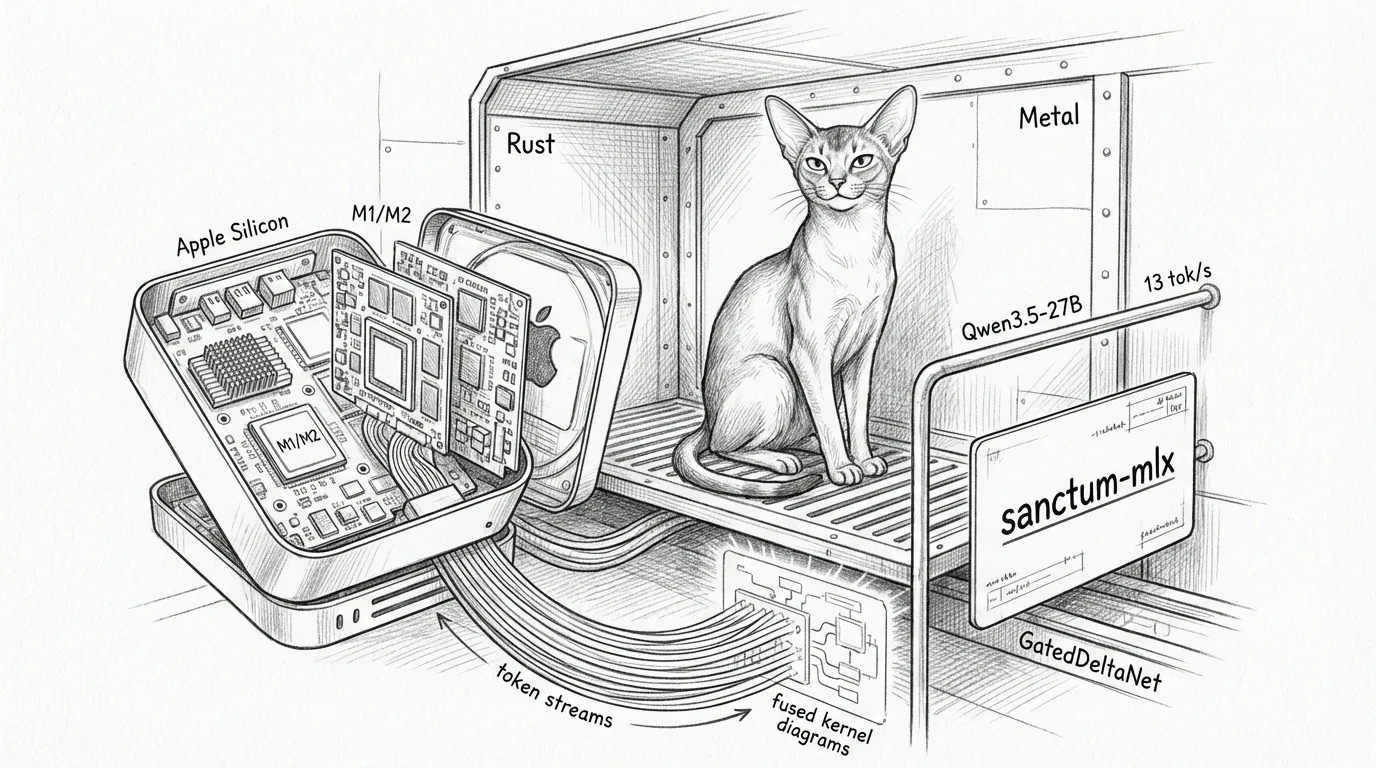
There was a time when the Council’s local inference ran through mlx_lm.server, a Python process that loaded a model and generated tokens. It worked. It was fine. Then the profiler showed 40% of the wall clock going to Python overhead, garbage collection, and the seven layers between “give me a token” and the actual GPU math.
So we did the unreasonable thing: rewrote the stack in Rust, implemented a GatedDeltaNet state-space model from scratch, wrote custom Metal kernels, and shipped a pair of binaries that start in 3 seconds and decode at 36–48 tokens per second. This is sanctum-mlx, the cathedral fork, on Apple Silicon Metal. No Python dependency. No regrets.
Cathedral fork — current state
Section titled “Cathedral fork — current state”The active inference layer is the cathedral fork at ~/Projects/sanctum-rs-cathedral/services/sanctum-mlx/; the original sanctum-rs/services/sanctum-mlx/ tree is deprecated, archival-only. Production drives two seats out of one binary:
| Binary | Port | Model | Role |
|---|---|---|---|
sanctum-mlx | mTLS :1337 | Qwen3.6-35B-A3B-4bit (MoE, model_type qwen3_5_moe) plus a Qwen3.6-27B-4bit secondary via dual-residency | Council seats (yoda, mothma, windu, cilghal, mundi, jocasta, quigon) |
sanctum-mlx (label com.sanctum.mlx-devstral-rust) | :3301 | Devstral-Small-2-24B-Instruct-2512-4bit | Coder seat + Qui-Gon’s code path |
The seats differ in exactly the ways their threat models differ:
| Seat | Manifest gate | Binds | Listener |
|---|---|---|---|
Council :1337 | ed25519-signed (ed25519 over shasum -a 256) | loopback, the Mini’s Tailscale IP, bridge100 10.10.10.1 (Lima VM path) | mTLS-only (--no-plain) — no plain-HTTP or bearer path left to bypass |
Devstral :3301 | plain SHA-256 (no .sig shipped for it yet) | loopback only, 127.0.0.1:3301 | local by design; the VM and MBP reach it through the council router, not directly |
Ahsoka satellite :1338 (chalet) | optional (warn-only until signed) | loopback 127.0.0.1:1338 | plain HTTP for openclaw; Qwen2.5-7B-Instruct-4bit via qwen2 path; runs as user sanctum |
The satellite seat is the same binary family (sanctum-mlx + colocated mlx.metallib), not a third fork. Field note: Ahsoka cathedral on the edge.
A disaster fallback, com.sanctum.mlx-py-fallback, sits promote-only on :8901 — the same Qwen3.6-35B-A3B-4bit as :1337 but an independent Python mlx-lm stack, so a corrupt or missing Rust binary (which kills both seats, since they share one binary file) still leaves a different-stack server able to take over at full parity. It is not always-warm: a resident 35B would sit ~20 GB on top of the live Rust 35B and push the 64 GB Mini deep into swap, so council-integrity-check promotes it only on unrecoverable Rust-binary failure — booting the broken agent to free RAM, then kickstarting the Python seat. Transient failover is handled a layer up, in proxyd routing (council-mlx to council-code to claude-cli-offline). Both Rust seats run under launchd (com.sanctum.mlx, com.sanctum.mlx-devstral-rust) with KeepAlive, load weights from disk, and never bind 0.0.0.0.
The sanctum-server smart router on :8900 (Smart Router Cathedral) fronts both binaries with four backends (council-secure, coder, spatial, cloud) and five tiers of defense: breaker, budget, latency EMA, quality detectors. Retired plumbing — the old :1338 coder seat, the socat :1234 bridges, all of LM Studio — is in the file map below.
Inside the server
Section titled “Inside the server”The request path never leaves Rust and Metal:
[Client] → mTLS handshake → 127.0.0.1:1337 (council, mTLS-only) ↓[sanctum-mlx (Rust/axum)] ├─ Manifest gate: ed25519 sig + SHA-256 verify before bind ├─ Loader dispatch by model_type → Qwen3.5MoE / Qwen2 / Qwen3.5 / Mistral ├─ 4-bit quantized inference: QuantizedLinear group_size=64 ├─ Fused Metal kernels: SDPA-dequant-V, Phase 1A QKV, Phase 1B Gate+Up ├─ Prompt cache pool with LCP matching (T_q ≥ 2 invariant) ├─ PLD self-speculation (cascading ngram lookup in prompt) ├─ Zero-copy GQA in the SDPA kernel ├─ Multimodal: vision tower for Qwen3.5-VL canary ├─ SSE streaming + non-streaming completions └─ /metrics (Prometheus), client-cert auth — mTLS-only, no plain/bearer listenerThe server exposes an OpenAI-compatible /v1/chat/completions endpoint, hot-swaps LoRA adapters (quantized + batched-quantized + 3-D switch_mlp for the MoE expert grids), and loads models straight from safetensors into mlx-rs arrays. The full graph runs on the Metal GPU without ever touching Python, NumPy, or the existential dread of pip install. It dispatches on the checkpoint’s model_type:
model_type | Status | Notes |
|---|---|---|
qwen3_5_moe | Production | Qwen3.6-35B-A3B-4bit MoE on :1337. Native multimodal (vision canary live 2026-05-10). |
qwen2 | Retired | Was Qwen2.5-Coder-14B-Instruct-4bit on :1338 (YaRN factor=4 RoPE scaling). Retired 2026-06-07; the coder role moved to Codestral-22B-v0.1-4bit on :3301. |
qwen3_5 (dense) | Reference | The original v0.2.0 27B-4bit path. Still in the loader; not the current production champion. |
mistral | Production | Devstral-Small-2-24B-Instruct-2512-4bit (Mistral-arch dense, text-only) on :3301. The "mistral" arm rebuilds the dense ModelInput from the shared fields — no linear-attention/SSM slots. |
| Mixtral (sparse MoE) | Not yet supported | The loader handles dense mistral but has no Mixtral expert-grid arm yet. Any other model_type is refused outright with a message naming the four it does load. |
Two cross-request tricks keep it fast and honest:
| Trick | Detail |
|---|---|
| LCP prompt-cache reuse | Matched on longest common prefix, capped at len - 2 so the suffix is always T_q ≥ 2 — MLX’s decode- and prefill-kernel SDPA diverge when the suffix is exactly one token, giving byte-different responses to byte-identical prompts; the two-token margin makes the cache byte-identical (commit 0123773) |
| PLD self-speculation | On by default on :1337 via SANCTUM_MLX_PLD_MAX_LOOKUP=5 and SANCTUM_MLX_PLD_NGRAM_SIZE=3; uses the prompt as its own draft model — no second model, no flash-attn wheel-build dance. Devstral sets no PLD env vars, so the coder seat runs the code default |
The fusion work that got the throughput here is tracked as shipped phases:
| Feature | Status | Effect |
|---|---|---|
| Phase 1A — FusedQKVProj | Shipped 2026-05-13 (commit 8da9d33, branch feat/cathedral-fused-qkv) | 24.1 → 36.3 tok/s freeform on coder, after fixing a split_sections view-aliasing bug — split returns non-contiguous views with non-zero offsets, downstream reshape→RoPE silently reads wrong bytes. + zero makes the contiguous copy. |
| Phase 1B — FusedGateUpProj | Merged 2026-05-14 (PR #16, commit f92d44e) | Coder essay throughput reached ~48 tok/s. Same + zero discipline; mlx_contiguous / mlx_copy are NOT substitutes. |
| Phase 2 — Fused RoPE Metal kernel | Designed, not shipped (branch feat/cathedral-phase2-fused-rope @ 6378408) | MSL kernel is correct in isolation, but MLX’s lazy graph doesn’t auto-track custom-kernel outputs; the eval barrier costs more than the two saved launches. Waiting on an upstream MLX fix. |
| Per-MoE-expert fusion (planned for 35B) | Pending | Carry-forward of Phase 1A/1B onto qwen3_5_moe: per-expert MLP fusion instead of monolithic gate+up. |
The model: Qwen3.5-27B-4bit (and others)
Section titled “The model: Qwen3.5-27B-4bit (and others)”Qwen3.5 is a hybrid architecture — 64 decoder layers split between two attention mechanisms:
| Component | Count | Description |
|---|---|---|
| Linear Attention (GatedDeltaNet) | 48 layers | Recurrent SSM with gated delta updates. O(1) memory per token. |
| Full Attention (Qwen3NextAttention) | 16 layers | Standard multi-head attention with a twist: 2x Q projection split into queries + sigmoid gate. |
| Parameter | Value |
|---|---|
| hidden_size | 5120 |
| head_dim | 256 |
| num_attention_heads | 24 |
| num_kv_heads | 4 |
| linear_key_heads | 16 |
| linear_value_heads | 48 |
| linear_key_head_dim | 128 |
| linear_value_head_dim | 128 |
| Quantization | 4-bit, group_size=64 |
Six optimizations, ~9 to ~75 tok/s
Section titled “Six optimizations, ~9 to ~75 tok/s”Six changes took decode throughput from ~9 tok/s to ~75 tok/s on the same hardware — the first four GatedDeltaNet-shaped wins from the v0.2.0 cutover, the last two the late-April push that closed the TurboQuant tax and bounded MLX’s buffer cache. John Carmack (Carmack Optimization) would probably find another 21%, but he’s busy.
| # | Optimization | Mechanism | Win |
|---|---|---|---|
| 1 | Fused Metal kernel for the GatedDeltaNet SSM (metal_kernels.rs) | One Metal dispatch processes all timesteps in a single GPU launch — was a Rust loop issuing a separate dispatch/sync per timestep; SIMD-group simd_sum reductions over the Dk dot products, recurrent state in thread-local registers | decode ~9 → ~13 tok/s |
| 2 | Zero-copy GQA in the kernel | 16 key heads → 48 value heads mapped internally via hk_idx = hv_idx / (Hv / Hk), reading the original 16-head Q/K — no broadcast, reshape, or allocation | no per-pass V buffer |
| 3 | Eval-cadence tuning | MLX is lazily evaluated; the graph executes on eval(), so the sync interval is a knob (see table) | halves GPU sync overhead |
| 4 | Pre-computed normalization constants | Q/K RMS-norm ones_weight + scale factors (inv_scale² for Q, inv_scale for K) computed once at model construction and cached, not fresh per call (was 48 layers × 2 arrays × every token) | fewer allocations |
| 5 | Fused attention with inline V dequant (sdpa_dequant_v) | One threadgroup per (batch, query head, query position); 32 threads cooperate on D via simd_sum; online (FlashAttention) softmax in fp32; causal mask via additive -INF bias, template-specialized so decode compiles the branch away. Routes through a new KeyValueCache::fused_attention trait method; when the cache opts in, FullAttention::forward skips full-V re-materialization for decode AND prefill | +21.2% |
| 6 | Metal memory caps + inter-request cache drain | Plist caps Metal; mlx_clear_cache (wrapped as mlx_rs::memory::clear_cache()) drains the cache at the end of both the sync and SSE chat handlers | bounded RAM |
The fused SSM kernel tiles the work so each threadgroup handles one (batch, value_head, dv_slice), loops all timesteps internally, and spreads Dk across 32 SIMD lanes:
Grid: (32, Dv, B*Hv) Threadgroup: (32, 4, 1)Eval cadence trades a sliver of latency for throughput:
| Mode | Before | After | Rationale |
|---|---|---|---|
| Streaming | Every 4 tokens | Every 8 tokens | Halves GPU sync overhead. Adds ~80ms latency at 13 tok/s — imperceptible in chat. |
| Non-streaming | Every 32 tokens | Every 64 tokens | Larger graph batches for throughput. The GPU prefers big meals. |
Optimization 5 hurt to get right. Slice 1 of TurboQuant rebuilt the entire dequantized V tensor every decode step on the CPU — O(T²) work and a forced GPU sync per layer. The replacement, sdpa_dequant_v (in turboquant/attention_kernel.rs), takes Q + materialized K + the compressed V state (indices, scales, zeros) and runs SDPA with V dequantized inline in registers — no full V tensor ever materializes:
Grid: (32, 1, B*H_q*L_q) Threadgroup: (32, 1, 1)| Config | Mean tok/s | vs Slice 1 |
|---|---|---|
| no TurboQuant | 79.42 | — |
| Slice 1 (CPU K+V) | 62.38 | baseline |
| Slice 4a-final (plain K + fused V) | 75.64 | +21.2% |
Keys-plain is an empirical choice: at our context lengths, dropping key compression saves the CPU round-trip without surrendering meaningful memory (~4 MB/layer of bf16 K is nothing on 64 GB). The full pivot story lives in TurboQuant KV Compression. (Bench: MBP M4 Max, 3 × 8 × 100 tokens, vanilla MoE.)
Optimization 6 fixed memory pressure. The Mini sat at 31.7 GB of 32 GB swap with 85 MB free pages — not a leak, just MLX’s buffer cache ratcheting up across thousands of requests, unbounded:
# 27B-era caps (this 2026-04-24 push):--metal-cache-limit-mb 1024 --metal-memory-limit-mb 40960 --metal-wired-limit-mb 24576# without these, MLX's cache limit was effectively 65 GB (the whole machine)
# live 35B champion caps:--metal-memory-limit-mb 28672 --metal-wired-limit-mb 18432 # cache limit still 1024| Steady state | 27B-era (2026-04-24) | live 35B champion |
|---|---|---|
| Wired | ~13 GB (weights + warm experts) | more resident weight |
| Free pages | 1.3 GB | — |
| Swap | shrank 32 GB → 9.2 GB once pressure eased | ~28.7 GB, ~27.5 GB used |
The bounding logic is the same win; the constants moved with the model. macOS shrinking the swap file on its own was the clearest signal it took.
The April 2026 cutover
Section titled “The April 2026 cutover”For a while, sanctum-mlx was a science project: it loaded models, ran the forward pass, produced valid tensors — it just wasn’t the thing answering your questions. Production still routed through the Python mlx_lm.server that sanctum-server babysat. April 2026 is when we flipped the switch. Four pieces landed in one push:
| Piece | What it does |
|---|---|
| LoRA merge at load | AppState::load calls lora::load_and_merge when --adapter-path is supplied. Quantized path dequantizes → adds the delta → requantizes at group_size=64, bits=4; non-quantized just adds. AdapterInfo { name, rank, alpha, merged_pairs } rides the app state and surfaces in system_fingerprint. |
| Full sampling pipeline | A sampling module replaces the single-temp qwen3_5::sample(): repetition penalty → top-p nucleus → temperature → argmax or categorical. RecentTokens is a bounded dedup-aware ring buffer; OpenAI stop is string-or-array; a StopSeqBuffer carries max-stop-length bytes across SSE batches so a stop split across the 8-token flush still trips. |
| Custom decode loop | sampling::decode drives Model::forward with a Control::Continue/Stop callback that batches token IDs. Replaces qwen3_5::Generate so top_p and repetition_penalty actually affect logits without patching vendored mlx-lm. |
| Multimodal config | The production mlx-community/Qwen3.5-27B-4bit checkpoint is the VL variant — text_config nests the text-model fields. get_qwen3_5_model_args flattens text_config into the root before deserializing; root-level keys win on conflict. |
The production cutover itself was a 65-second blue-green swap at 2026-04-17 21:36 local — 63 of those seconds were Metal loading 27 billion 4-bit parameters into the GPU, the other two were launchctl.
| Change | Detail |
|---|---|
| Python wrapper unloaded | com.sanctum.server-mlx.plist (wrapper on mlx_lm.server) off |
| Rust binary loaded | com.sanctum.mlx.plist on :1337, KeepAlive=true, LimitLoadToSessionType=Aqua, ThrottleInterval=30 |
| Guardian rewrite | council-guardian.sh now uses launchctl kickstart -k gui/<uid>/$ACTIVE_AGENT; rollback = flip ACTIVE_AGENT back to com.sanctum.server-mlx |
| Guardian probe latency | ~870 ms → ~485 ms (a ping, not a generation — but a faster ping) |
At cutover we hit 7/10 byte-exact on the smoke battery at temperature=0; the remaining three differ only in single-word synonyms — bf16 ULP drift after ~100 characters, argmax identical for the first ~40 tokens on every prompt. Rollback is one line, and server-mlx.plist is the escape hatch, not legacy debt — kept until the 24-hour watch is clean and a week of guardian probes match the Python era’s 100%:
launchctl unload ~/Library/LaunchAgents/com.sanctum.mlx.plist && \ launchctl load ~/Library/LaunchAgents/com.sanctum.server-mlx.plistThe bugs that made it work
Section titled “The bugs that made it work”These took the longest to find and shortest to fix. Load a Qwen3.5-27B base model, send one prompt, and sanctum-mlx produced a few coherent tokens then collapsed into "Hello, and the 190/ / 190/ / …". The tokenization, the special tokens, the sampler, the weights — all right. And yet. Five bugs stood between the science project and production:
| Symptom | Root cause | Fix |
|---|---|---|
First tokens coherent, then a 190/ / loop | The 48 GatedDeltaNet SSM layers carried no state across forward calls — only the 16 full-attention layers had a KV cache, so every L=1 decode step ran with a fresh zero SSM state h ∈ ℝ^{B × H_v × D_v × D_k} and a zero-padded depthwise causal Conv1d; the amnesiac layers cascaded garbage until greedy decode locked on a self-reinforcing token | forward_with_cache(&mut self, x, cache) threads a LinearAttentionState; None = prefill, Some = decode continuation; ModelInput gained ssm_cache; the old Module::forward(&Array) delegates with None |
Segfault in mlx_array_data_bfloat16 | Array::deep_clone() on unevaluated lazy tensors — the buffer pointer is null until eval(); the no-op branches of sample/apply_top_p/apply_repetition_penalty cloned prefill logits before they materialized | Pass &Array through every stage, materialize only when a transform runs; a fast path for temp=0 + no rep-penalty goes straight to argmax with zero intermediate Arrays |
| Degenerate token loops | Missing <think>…</think> prompt prefix — Python runs --chat-template-args {"enable_thinking": false}, emitting <|im_start|>assistant\n<think>\n\n</think>\n\n; we sent only <|im_start|>assistant\n | messages_to_prompt now matches production exactly |
Parity stuck 4/10 at temperature=0 | FullAttention saw an empty cache Vec, fell through to the no-cache branch, and silently recomputed keys/values every decode step | A C: Default trait bound + `(0..self.layers.len()).map( |
Every decode step corrupted, exp(0)=1 collapsing the GatedDeltaNet decay | Field named a_log; the ModuleParameters derive uses stringify!(field) for checkpoint lookup and Qwen’s safetensors key is A_log — lowercase silently mismatched | Rename a_log → A_log (the software equivalent of losing a year to a missing semicolon) |
The state struct threads two things through the decode loop:
pub struct LinearAttentionState { /// GatedDeltaNet matrix memory: h[t] = state * g + k * ((v − state@k) * beta) pub ssm_state: Array, // [B, num_value_heads, value_head_dim, key_head_dim] /// Previous (conv_kernel_dim - 1) raw QKV projections. pub conv_buffer: Array, // [B, K-1, qkv_dim]}The correctness test is short and brutal: a full prefill of L=6 must equal a prefill of L=5 plus one decode step through the cache.
let y_full = la.forward_with_cache(&x6, &mut None)?;la.forward_with_cache(&x5, &mut cache)?;let y_step = la.forward_with_cache(&x1, &mut cache)?;assert!(max_abs_diff(&y_full.last(), &y_step) < 1e-3); // 6th-position output matches both waysOn the real model, "Say hello." went from the 190/ / loop to "Hello! How can I help you today? …". Python mlx_lm.server emits EOS at “today?” — a ~50-token drift that is numerical-parity refinement, not a correctness bug.
The firewall ambush
Section titled “The firewall ambush”Localhost worked. The guardian worked. Every probe from the MacBook Pro over Tailscale got curl: (56) Recv failure: Connection reset by peer. The socketfilterfw ruleset had silently added the unsigned Rust binary to the BLOCK list — probably during an earlier shadow test, when the Application Firewall popup went unanswered at the Mini’s screen. Localhost bypassed the filter, so every developer probe looked fine.
# Diagnose/usr/libexec/ApplicationFirewall/socketfilterfw --getappblocked \  /Users/neo/Projects/sanctum-rs/target/release/sanctum-mlx# → "Incoming connection to ... is blocked."
# Fix (one-shot, requires sudo)sudo /usr/libexec/ApplicationFirewall/socketfilterfw --unblockapp \  /Users/neo/Projects/sanctum-rs/target/release/sanctum-mlx
This bites once per binary path: a rebuild at the same path keeps the rule, a moved binary starts default-deny again. Python mlx_lm.server never hit it — its executable was Python.app, allow-listed for decades. Rust binaries from cargo build --release are ad-hoc-signed (codesign -dv shows Signature=adhoc) and enjoy no such privilege.
The guardian that ate itself
Section titled “The guardian that ate itself”The rewritten guardian passed every test, then the Sanctum Olympics benchmark hit the Mini with 512-token prompts and the guardian decided the server was dead. It wasn’t. sanctum-mlx serializes Metal inference — one GPU context, one kernel graph at a time — so a POST /v1/chat/completions health probe with max_tokens=2 queued behind a max_tokens=512 request in flight, timed out after 20 seconds, and the guardian read that as “hung” and ran launchctl kickstart -k. Three restarts in eight minutes; none necessary, all outages.
# Before — queues behind in-flight inference under loadURL="http://127.0.0.1:1337/v1/chat/completions"curl -X POST "$URL" -d '{"messages":[{"role":"user","content":"ping"}],"max_tokens":2}'
# After — GET, ~25 ms, bypasses the inference queueURL="http://127.0.0.1:1337/v1/models"curl "$URL"
The fix probes GET /v1/models (~25 ms regardless of load, because it never touches the model graph), tightens the timeout from 20s to 10s, and loosens FAILS_BEFORE_RESTART from 2 to 3. If the graph goes sideways while HTTP stays alive, this probe won’t catch it — a separate, slower monitor covers that.
Latency and testing
Section titled “Latency and testing”Warm-up on the first request after a plist load is ~15 s (Metal context + kernel JIT). After that, latency is flat until the KV cache grows past the working-set window — at which point the linear-attention recurrent state keeps memory bounded instead of the usual quadratic heartburn at the 32K mark.
| Workload | Latency | Throughput |
|---|---|---|
Guardian ping (max_tokens=2) | ~450 ms | — |
Short chat (max_tokens=8, warm) | ~520 ms | ~15 tok/s |
Paragraph (max_tokens=80) | ~4.2 s | ~13 tok/s |
The M4 Pro 128GB baseline (2026-04-02): the fused kernel roughly doubled decode while leaving prefill flat, because prefill is dominated by matrix multiplications through 64 quantized layers, not the SSM scan.
| Metric | v0.1.0 (Rust loop) | v0.2.0 (fused kernel) |
|---|---|---|
| Prefill | ~5 tok/s | ~5 tok/s |
| Decode | ~9 tok/s | ~13 tok/s |
| Model load | ~3s | ~3s |
| Binary size | ~4.2 MB | ~4.2 MB |
The e2e suite ships alongside: test_e2e_sanctum_mlx.sh supports --skip-build and covers the full OpenAI-compatible surface, error handling and graceful SIGTERM shutdown included.
| Metric | Value |
|---|---|
| Unit tests (sampling + server + lora + turboquant) | 74/74 |
SSM cache tests (prefill, decode, full == prefill+decode) | 3/3 |
| E2E tests | 34/34 |
| Phases | 10 (build, health, deep health, models, non-stream, stream, errors, multi-turn, content arrays, shutdown) |
Hardening: from B+ to A+
Section titled “Hardening: from B+ to A+”With the binary live, the gap was operational: nobody would notice if the server answered wrong but still returned 200, if a hand-edited plist drifted from the repo, or if a corrupted weights file served a bad token. Successive passes closed those gaps until “military-grade” was earned — observable, survivable, verifiable, identity-gated:
| Layer | Mechanism |
|---|---|
| Guardian | council-guardian, every 60s, GET /v1/models — proves HTTP is alive, nothing more |
| Canary | council-canary, every 10 min, POSTs “What is 2+2? Respond with only the number.” Response must contain 4; two consecutive misses alert Force Flow /notify (the pipe signal-health uses), 30-min cooldown; it never restarts (guardian owns that) |
| Drift | council-drift, hourly, SHA-256-compares every deployed plist/script/manifest against canonical copies in services/sanctum-mlx/deploy/ in the Mini’s sanctum-rs checkout; checks the Application Firewall state and asserts every expected agent is loaded; drift → level=error log + Force Flow alert. deploy-sanctum-mlx.sh verify runs it interactively |
| Deploy | scripts/deploy-sanctum-mlx.sh — install idempotent (SHA-compare each artifact), upgrade (native arm64 + Metal rebuild, MBP-shadow pre-flight, unload+load not kickstart -k, post-flight chat probe, auto-rollback), rollback → com.sanctum.server-mlx |
| Weight manifest | manifest.rs reads a coreutils shasum -a 256 manifest (services/sanctum-mlx/deploy/qwen35-27b-4bit.manifest.sha256), rayon-parallel-hashes files under --model, refuses to bind on mismatch; 6 unit tests; 10.5 s for 9 files / 16 GB on the Mini’s NVMe; startup ~27 s → ~38 s |
| ed25519 signature | Detached ed25519 signature over the manifest bytes, verified before the hashes. Signing key on the MBP at ~/.ssh/sanctum-manifest-signing.key (0600, not in repo); 32-byte verify key services/sanctum-mlx/deploy/manifest-pubkey.ed25519 and 64-byte sig ...manifest.sha256.sig are committed. sign_manifest CLI (keygen/sign/verify); a tamper test reproduces Verification equation was not satisfied |
| Bind restriction | --host is repeatable, default single 127.0.0.1; non-loopback bind failures are non-fatal (Tailscale flaps at boot), loopback is required; is_unspecified() also counts as loopback so the MBP shadow’s 0.0.0.0:8902 passes the start guard |
| Bearer auth (retired) | auth.rs axum middleware, 127.0.0.1/::1 bypass else Authorization: Bearer <token>, constant-time compare via subtle; token at /Users/neo/.sanctum/secrets/council-mlx.token (0600, 64 bytes of secrets.token_hex(32)), --auth-token-file, fail-closed 401, SANCTUM_MLX_DISABLE_AUTH=1 to opt out. Rode along during the mTLS transition, retired with the plain listener |
| Off-box watchers | On the MBP: com.sanctum.council-canary-offbox (chat probe via Tailscale, every 10 min) + com.sanctum.council-drift-offbox (deploy-sanctum-mlx.sh verify hourly against the Mini). Alert is osascript 'display notification' with a “Submarine” sound — Force Flow is deliberately not used, since the premise is the Mini might be dead |
| Hardened runtime | scripts/codesign-sanctum-mlx.sh re-signs with --options runtime + only com.apple.security.cs.allow-jit (Metal’s W^X shader pages); codesign -dv shows flags=0x10002(adhoc,runtime); no disable-library-validation |
| Developer ID + notarization | Identity Developer ID Application: Bertrand Nepveu (GJ994MN2YF), full three-link Apple chain, flags=0x10000(runtime). ASC API key .p8 at ~/.keys/holocron-notary/AuthKey_PLACEHLDR0.p8; notarytool store-credentials sanctum stashes it in keychain. Submission IDs: MBP 00000000-0000-0000-0000-000000000004, Mini 00000000-0000-0000-0000-000000000005, both Ready for distribution |
Prometheus /metrics | src/metrics.rs — RED metrics + inference token counters (see below); reachable only over the mTLS socket now |
| HA failover | HttpProxyBackend holds a Vec<String>; generate tries primary then each fallback on connect-failure/5xx, bails on 4xx, and stays on a URL once a stream starts; BackendDef.fallback_urls in instance.yaml; health_check is “healthy if ANY url responds” |
| Parity smoke | com.sanctum.council-parity-smoke, 03:00 nightly, 10 fixed prompts at temperature=0 vs known-good substrings in parity-smoke.json; more than 1/10 failures fires Force Flow. Initial prod run 10/10, ~60 s |
| mTLS | src/mtls.rs + scripts/mtls-gen-certs.sh; PKI at ~/.sanctum/certs/; per-client certs give cryptographic identity (the CN lands in audit logs), individually revocable without re-issuing everyone |
One wrinkle: CLI Mach-O binaries can’t be stapled, so Gatekeeper fetches the ticket online on first run; the authoritative proof lives in ~/.openclaw/logs/notarization-<id>.log. SSH codesigning on the Mini needs a one-time keychain ACL, or codesign gets errSecInternalComponent:
security set-key-partition-list -S apple-tool:,apple:,codesign:,unsigned: \ -s -k <login-pw> ~/Library/Keychains/login.keychain-dbThe Prometheus series and the router fallback config, for whoever wires the dashboard:
sanctum_mlx_http_requests_total{route,method,status} countersanctum_mlx_http_duration_seconds{route,method,status} histogram (5 ms – 180 s)sanctum_mlx_http_inflight_requests gaugesanctum_mlx_inference_requests_total{stop_reason} countersanctum_mlx_inference_{completion,prompt}_tokens_total counterssanctum_mlx_inference_duration_seconds histogramsanctum_mlx_inference_tokens_per_sec histogram (0.5 – 96 tok/s)sanctum_mlx_inference_completion_tokens histogram (1 – 4096 tokens)sanctum_mlx_startup_seconds{phase="manifest_verify"|"model_load"} histogramsanctum_mlx_model_loaded gauge (0/1)council-secure: url: http://127.0.0.1:1337/v1 fallback_urls: - http://100.0.0.55:8902/v1 # MBP shadow via Tailscale api_key_env: COUNCIL_API_KEYcerts/├── ca.crt, ca.key self-signed EC P-256 CA (5-year validity)├── server.crt, server.key server cert, SAN'd for every address sanctum-mlx binds└── clients/ ├── guardian.{crt,key} per-client cert, CN=<client-name> ├── canary.{crt,key} ├── drift.{crt,key} ├── parity-smoke.{crt,key} ├── sanctum-server.{crt,key} └── council-offbox.{crt,key}Verified cross-machine: a curl from the MBP to https://100.0.0.25:1338/v1/chat/completions (with --cacert ca.crt plus the sanctum-server client cert and key) returned "2 + 2 equals" in 1.84 s; without a client cert the handshake is rejected at layer-4 with rustls reason 1116. The migration is done: the plain listener is gone, mTLS on :1337.
Still open
Section titled “Still open”None of these block day-to-day operation — they’re the layers that keep you boring when boring is what you want.
| Still open | What it needs |
|---|---|
The 3/10 bf16 ULP parity gap at temperature=0 | An fp32 accumulator in the fused Metal kernel, or reduction-order surgery / selective fp32 promotions |
| Parity smoke battery inside GitHub Actions CI | A self-hosted arm64 runner — GitHub’s can’t drive Metal (the nightly cron covers it off-CI for now) |
| True HA (multi-node council) | Active-passive or load-balanced across Mini + MBP |
| Zero-downtime blue-green | A Caddy front-proxy hot-swapping a :1337/:1338 pair |
File map
Section titled “File map”All paths are in the cathedral fork at ~/Projects/sanctum-rs-cathedral/. The original ~/Projects/sanctum-rs/services/sanctum-mlx/ tree is deprecated and archival-only — anything new lands in the cathedral.
| File | Description |
|---|---|
services/sanctum-mlx/src/main.rs | CLI (clap), axum routes, server setup, manifest gate before Metal load |
services/sanctum-mlx/src/server.rs | Inference pipeline, SSE streaming, ChatML prompt formatting, StopSeqBuffer, sampling_params_from_request |
services/sanctum-mlx/src/loaded_model.rs | Loader dispatch by model_type (qwen3_5_moe / qwen2 / qwen3_5 / mistral); PLD orchestration; LCP cache reuse |
services/sanctum-mlx/src/sampling.rs | Full sampling pipeline: SamplingParams, RecentTokens ring buffer, apply_repetition_penalty, apply_top_p, sample, callback-based decode |
services/sanctum-mlx/src/lora.rs | LoRA adapter merge (quantized + batched-quantized + 3-D switch_mlp for MoE experts) |
services/sanctum-mlx/src/manifest.rs | Ed25519-signed SHA-256 weight manifest verify, rayon-parallel; refuses to bind on mismatch |
services/sanctum-mlx/src/turboquant/ | 4-bit value cache + fused Metal sdpa_dequant_v kernel (Slice 4a-final: plain K + fused V) |
services/sanctum-mlx/src/multimodal/ and src/vision/ | Vision tower for Qwen3.5-VL multimodal canary |
services/sanctum-mlx/src/mtls.rs | rustls server + per-client cert auth, CA at ~/.sanctum/certs/ca.crt |
services/sanctum-mlx/src/metrics.rs | Prometheus recorder, RED metrics, inference token counters |
services/sanctum-mlx/deploy/ | Versioned plist + guardian + canary + drift agents; canonical copies for drift check |
services/sanctum-mlx/test_e2e_sanctum_mlx.sh | End-to-end mTLS canary battery |
~/Library/LaunchAgents/com.sanctum.mlx.plist | Council :1337 runtime config — mTLS-only (--no-plain, --tls-host ×3), SANCTUM_MLX_FUSED_QKV=1, FUSED_MLP=1, PLD env vars, prewarm file, ed25519-signed manifest paths |
~/Library/LaunchAgents/com.sanctum.mlx-devstral-rust.plist | Coder :3301 runtime config (Devstral-Small-2-24B-Instruct-2512-4bit) — --host 127.0.0.1 loopback-only, plain SHA-256 manifest (no .sig), no PLD env vars |
~/Library/LaunchAgents/com.sanctum.mlx-coder.plist | RETIRED 2026-06-07 — was the coder :1338 runtime config (YARN factor=4, fused QKV/MLP, same PLD knobs); removed when the coder role moved to Codestral |
~/Library/LaunchAgents/com.sanctum.coder-plain-bridge.plist | RETIRED 2026-06-07 — was the socat plain-HTTP :1234 → mTLS :1338 shim for legacy callers; gone with the LM Studio decommission |
~/Library/LaunchAgents/com.sanctum.lmstudio-bridge.plist | RETIRED — the orphan socat LISTEN 10.0.0.1:1234 → 127.0.0.1:1234 (dead backend) that outlived the LM Studio decommission; now unloaded, and :1234 is closed |
The achievement is boring: 27 billion 4-bit parameters answering on a 64 GB Mac Mini, zero Python in the request path, and enough hardening around it that nobody has to think about it.