

The Temple of the Kyber
The fibre drops. Opus stops answering; Gemini times out. Most stacks would stall right here — a spinner, a 503, a page that never loads. This one reaches into a closet in Montréal instead.
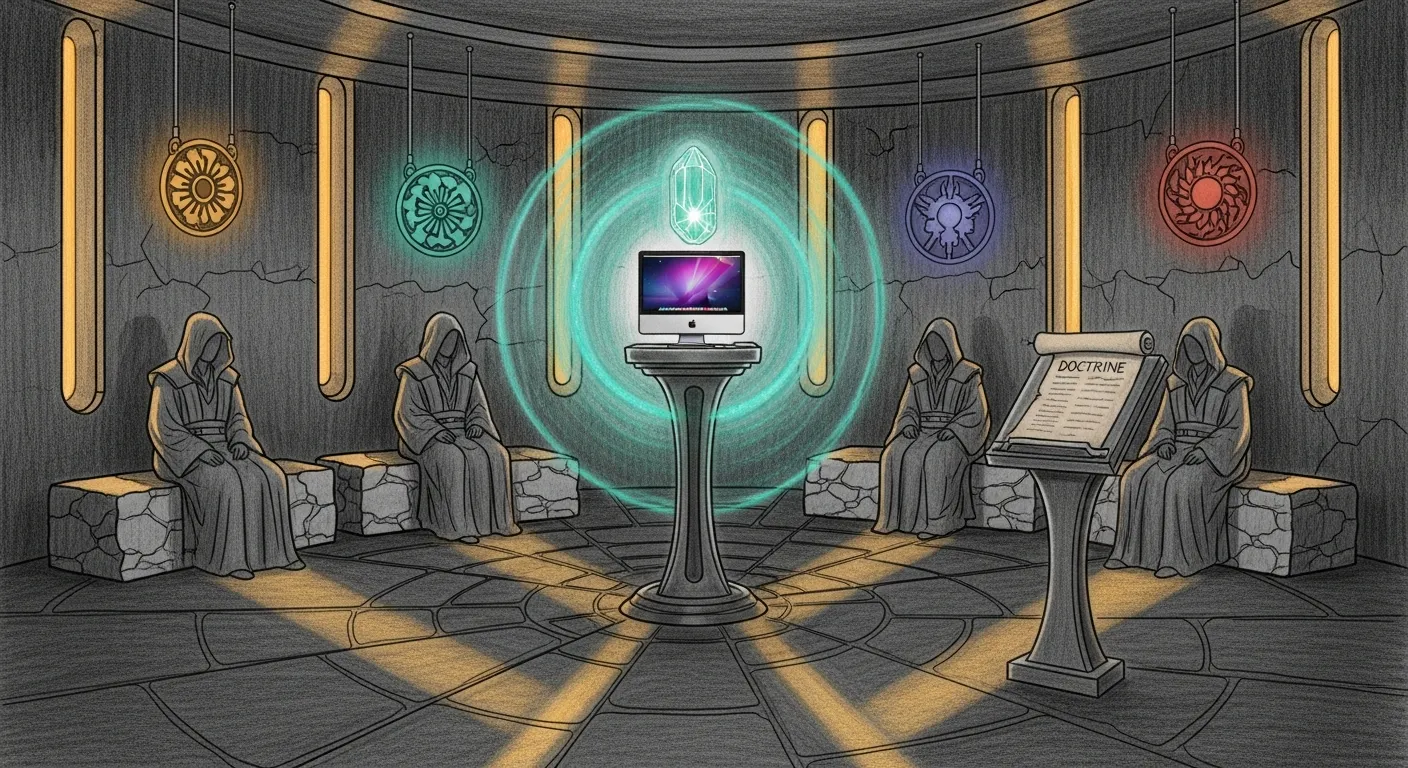
Two characters do most of the dramatic work in the Sanctum mythology, and almost every page in this section is a footnote on one of them. The first is the Temple of the Kyber — a Rust binary on a Mac Mini in Montréal that serves a 35-billion-parameter language model under mTLS. The kyber it holds is the model itself: a 4-bit-quantised Qwen3.6 MoE checkpoint, 20 GB on disk, attuned to whichever Jedi reaches for it. The second is the Council — seven seats led by five specialised Jedi who route their reasoning through three different model providers and return to the Temple when those providers don’t answer (with Jocasta keeping the records and Mon Mothma keeping the lights on).
This page is the narrative entrypoint. The technical detail lives in Sanctum MLX, Council Router, Agents Architecture, and the per-Jedi pages under Agents in the sidebar. Read those when you need the wiring. Read this when you need the story.
The Temple
Section titled “The Temple”A thirty-megabyte Rust binary called sanctum-mlx, running on a 64 GB Mac Mini under launchd, serving Qwen3.6-35B-A3B-4bit-text on :1337 mTLS-only (plus a Qwen3.6-27B-4bit secondary via dual-residency). There is one inference in flight at a time, on purpose. There is no plain HTTP listener, also on purpose. There is a vision tower armed in the same process that can describe an image you POST as base64. There is no Python.
The Temple holds the kyber. A kyber crystal is the singular component a Jedi carries that lets them act in the world — without it, the saber is a hilt. The Temple’s kyber is the local model checkpoint: when the cloud doesn’t answer, the Council still has somewhere to reach. Slower than Opus or Gemini. Reachable from a closet.
The metaphor is load-bearing. When fibre is up and the API budget is not yet exhausted, most of the Council reaches for cloud sabers — Anthropic’s Opus 4.8, Google’s Gemini Pro. When either of those goes dark, every Jedi can still attune to the kyber here and receive an answer in seconds. Operationally the binary is sometimes still nicknamed the cathedral in chat and commit messages — that nickname is older than this page; the kyber framing is the canonical one.
| Layer | What |
|---|---|
| Stone | sanctum-mlx Rust binary, vendored mlx-rs + mlx C++ 0.30.6 |
| Kyber | ~/.cache/huggingface/hub/models--mlx-community--Qwen3.6-35B-A3B-4bit (20 GB on disk, ~16 GB resident at startup) |
| Vestments | TurboQuant KV compression (1.32× ratio) and a Carmack-passed vision tower (333 tensors, depth 27) |
| Doors | mTLS on three TLS hosts: 127.0.0.1, the Tailscale address, and 10.10.10.1 (the bridge to the OpenClaw VM). No door without a client cert. |
| Discipline | A dedicated mlx-inference executor thread owns every text-path inference — one OS thread, one durable GPU stream, jobs queued FIFO with the dispatch lock held inside each un-cancellable job. Multimodal handlers serialize against it through the same lock. One inference at a time, by construction. |
| Vows | KeepAlive=true under launchd, plus a 60-second supervision check, plus a restart-forensics capture, plus a Sunday 04:00 perf-hygiene cron |
| Witnesses | A vision-canary every 60 seconds probes /v1/models and a 1×1 PNG multimodal request. On three consecutive 1h SLO breaches it flips a kill-switch that downgrades vision in the next restart. |
For the implementation detail — TurboQuant, the fused Metal kernel, the Carmack vision-tower wins — start at Sanctum MLX. For the request-tier defense in front of the Temple, see the Smart Router Cathedral (which is a separate metaphor — the five-tier router that decides whether a request reaches sanctum-mlx at all).
The Council
Section titled “The Council”Five Jedi, a two-seat bench, three model families. Each owns a domain. Each routes to the saber best-suited to it. Each falls back to the Temple’s kyber if their primary backend goes quiet. Each emits a briefing on a schedule, and as of the Vision Probe Lied sweep, every briefing is silent on green and alert-only on red.
Who runs on which model is one fact the Temple does not keep here. It lives in one place — src/data/council-roster.json, regenerated from the live Mini config by pnpm refresh:council — and every page that needs it embeds the same component. A champion swap is one refresh and one rebuild; no page goes stale by hand:
| Agent | Logical tier | Resolved primary | Fallback chain |
|---|---|---|---|
| Yoda | council-tiered/council-max-thinking | claude-fable-5 (Claude Max bridge (local)) | Qwen3.6-35B-A3B-4bit-text |
| Ki-Adi-Mundi | council-tiered/council-finance | grok-4.5 (Local) | Qwen3.6-35B-A3B-4bit-text |
| Qui-Gon | council-tiered/council-code | Devstral-Small-2-24B-Instruct-2512-4bit (sanctum-mlx-devstral (local, mTLS)) | Qwen3.6-35B-A3B-4bit-text |
| Windu | council-tiered/council-spacial | gemini-3.1-pro-preview (Local) | Qwen3.6-35B-A3B-4bit-text |
| Cilghal | council-tiered/council-heretic | qwen3.6-27b-4bit-champion-ablated (Local) | Qwen3.6-35B-A3B-4bit-text |
| Jocasta | council-crm | qwen3.6-27b-4bit (sanctum-mlx (local, mTLS)) | — |
| Mon Mothma | council-brain | claude-opus-5 (Claude Max bridge (local)) | — |
openclaw.json + sanctum-proxy/config.yaml at 2026-08-09T22:23:46Z. Every Jedi falls back to the
local Qwen tier if their primary path fails. Refresh via pnpm refresh:council.
What that table can’t tell you is what each Jedi is for, and when they speak:
| Jedi | Domain | Briefing |
|---|---|---|
| Yoda | Strategy, orchestration, voice | Morning synthesis at 08:00 EDT (com.sanctum.morning-briefing) |
| Ki-Adi-Mundi | Financial intel for Triptyq Capital — deal flow, portfolio, fund performance | Every 4h, fires only when deals go cold |
| Mace Windu | Security — firewall state, FileVault, ssh attempts, container health, network drift | Every 3h, fires only on alerts |
| Qui-Gon Jinn | Code and infrastructure | On-demand via @quigon |
| Cilghal | Health diagnostician — disk, RAM, load, services, VM, Docker | Every 3h, fires only on alerts |
Each individual Jedi has their own page under Agents, and the canonical full roster lives in Agents Architecture.
To convene them as a body, the operator runs:
tools/ask-council.sh "the question for the council"This routes around the Council Router (which can hang on stale session locks) and talks straight to the Temple, persona-injecting all four reasoning Jedi into a single call plus a verdict line. It is how architectural A/B/C decisions are made in this haus. The answer is not always right — the Council deferred shipping a streaming-handler mutex once when the operator’s intuition was correct to override — but it is reliably worth listening to before recommending a path to a human.
The Doctrine
Section titled “The Doctrine”Three rules carry the rest — and a fourth, named after a cat, decides the ties:
- Heterogeneous on purpose. Neurodiversity is Paramount. Three model families across the bench. One outage doesn’t take the whole Council.
- Cloud for the hard thinking, local for the workhorse seats. Yoda and Mundi lead with Opus, Windu with Gemini; Qui-Gon and Cilghal lead with the local kyber and the Devstral lane. Every seat keeps the Temple as a fallback, so the bench keeps working when the cloud doesn’t.
- Silent on green, alert-only on red. Every briefing now follows this. If you are getting a Force Flow ping, something actually needs you.