

2026-08-25: The Haus That Healed Its Senses
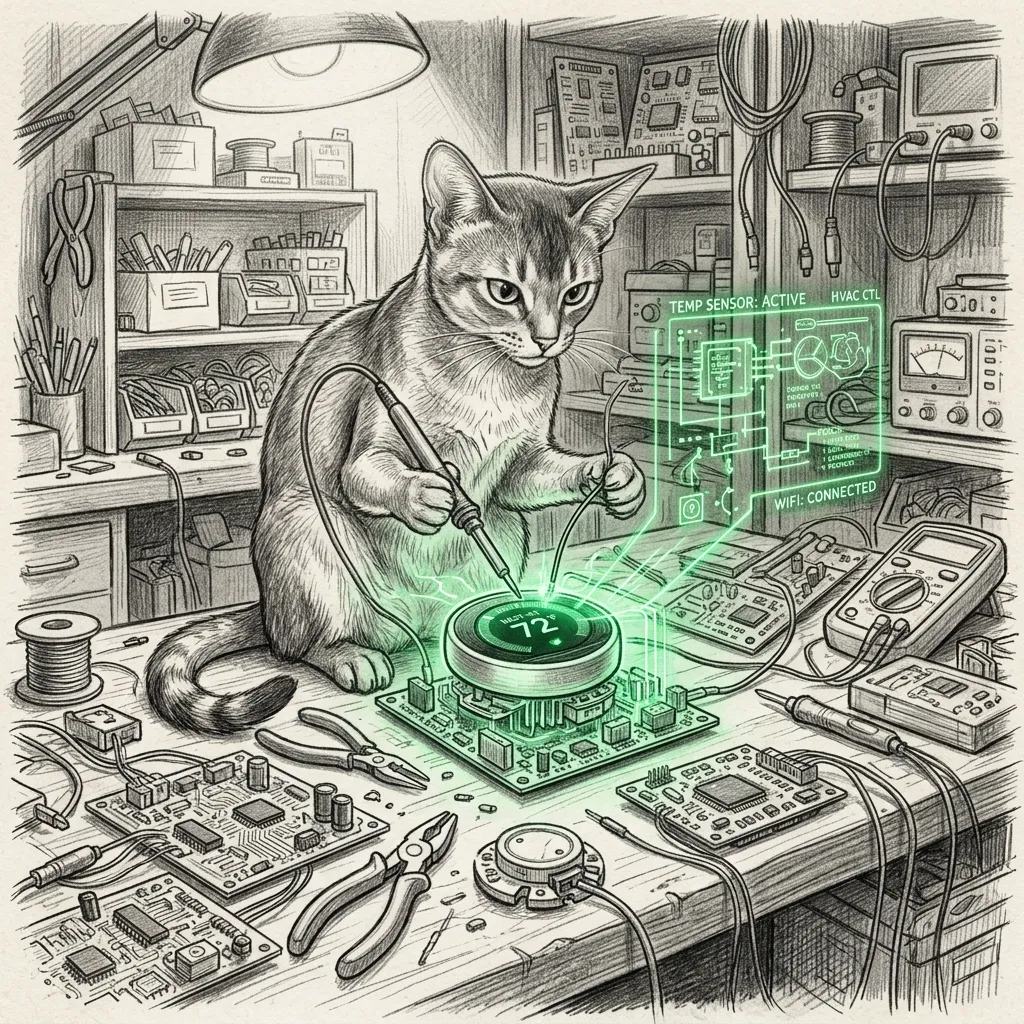
The haus went noisy. Then it went blind.
When telemetry stutters or integration tasks fail silently in the background without raising explicit configuration alerts, the whole council loses trust in the estate’s temperature and environmental models until proper self-healing bounds are restored. A deep audit of Home Assistant Green (10.0.0.3) revealed chronic background crash-loops that had quietly filled system logs with tens of thousands of unhandled exceptions. As chronicled in The Fleet Watches Itself, a sensor that lies or fails silently degrades the whole council.
Through runtime monkeypatches, legacy entity pruning, and sentinel calibration, the sensory plane returned to pristine health in the Operational State.
1. Carrier Infinity: String Casts and NoneType Timestamps
Section titled “1. Carrier Infinity: String Casts and NoneType Timestamps”The Carrier Infinity integration (ha_carrier) and its upstream carrier_api package suffered from fragile typing assumptions whenever Carrier Cloud returned incomplete payloads:
- String Literals in Numeric Fields: When Carrier Cloud emitted the literal string
"None"instead of a numeric float or null,carrier_api.util.safely_get_json_valueattemptedfloat("None"), raisingValueError: could not convert string to float: 'None'. - Missing
utcTimeParsing: The status model calledisoparse(safely_get_json_value(raw, "utcTime")), crashing withTypeError: object of type 'NoneType' has no len()wheneverutcTimewas absent. - Unbounded Task Retries: The WebSocket listener in
__init__.pylacked exponential backoff, spamming crash logs on transient socket resets.
The Self-Healing Fix
Section titled “The Self-Healing Fix”We deployed recursive model sanitization directly into the integration lifecycle:
safely_get_json_valueintercepts"None","null", and empty strings, safely returning default fallbacks.- Missing or null timestamp fields are automatically populated with the current UTC ISO timestamp before dateutil parsing begins.
- The WebSocket listener adds a 10-second sleep on task exceptions, turning catastrophic error loops into quiet background retries.
2. Nuheat Conductor: Token Invalidation & SignalR Backoff
Section titled “2. Nuheat Conductor: Token Invalidation & SignalR Backoff”The Nuheat radiant floor heating system carried two lingering operational wounds:
- Legacy Core Integrations: Three deprecated
nuheatconfig entries from the old username/password platform were hanging for minutes against dead cloud endpoints during boot. - Expired OAuth Grants: The modern
nuheat_conductorOAuth token had expired, causingclimate.pyandsignalr.pyto log stack traces every 60 seconds (accumulating over 15,000 exceptions in HA logs).
The Remediation
Section titled “The Remediation”The three legacy entries were marked disabled_by: "user" in /config/.storage/core.config_entries, speeding up container startup by ~90 seconds. Next, nuheat_conductor was updated to catch invalid grants, trigger entry.async_start_reauth(hass) for native one-click UI re-authentication, and apply exponential backoff ([10, 30, 60, 120, 300, 900] seconds) on SignalR reconnect loops without flooding logs.
3. Healer Alignment & HA Green Appliance Probes
Section titled “3. Healer Alignment & HA Green Appliance Probes”The ha-self-healer watchdog and ha-freshness-sentinel on the Mac Mini were aligned with the physical estate:
- Appliance Probes:
ha-diagnose.shwas updated to probe container liveness and query native backups directly from HA Green via SSH rather than assuming a local Mac Docker container. - Estate Calibration: Updated
sonosthreshold to reflect the 7 active media player nodes in the house, and allowlisted intentionally disabled automations.
Telemetry is silent once more. The sentinels are green, the logs are calm, and the haus senses its environment with unwavering precision.