

2026-10-22: The Sentinel That Patches the Fleet
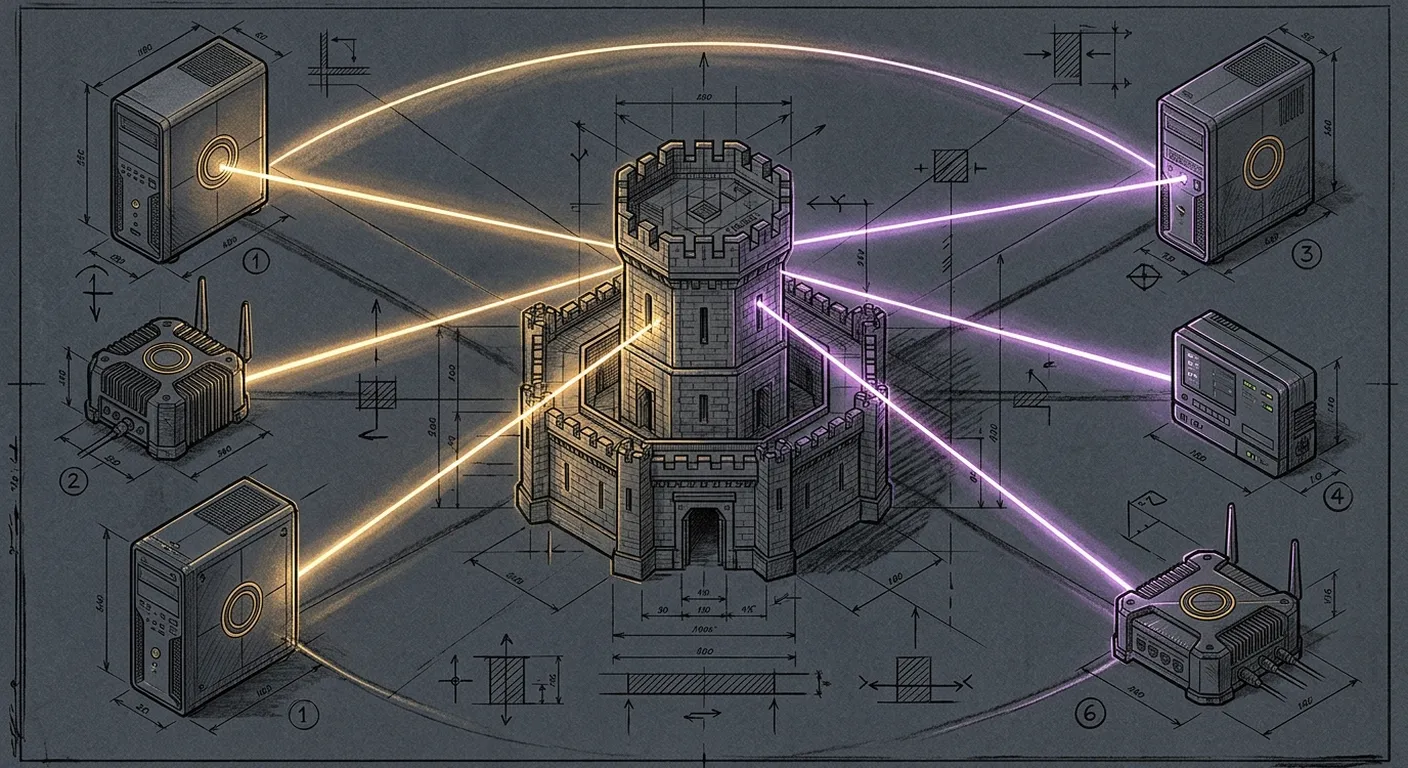
Six nodes sat on the tailnet, and four of them disagreed on what version of Tailscale they were running.
On the Mini, brew upgrade had bumped the /opt/homebrew/bin/tailscale CLI to 1.104.2 while the running com.tailscale.tailscaled LaunchDaemon stayed on 1.102.5. On the MBP, the CLI was 1.104.1 and the daemon was 1.102.5. On the two Firewalla routers, the Docker containers were frozen at 1.98.4 and 1.98.9—whatever tailscale/tailscale:latest had resolved to the day each container was first created. On Home Assistant Green, the Tailscale add-on sat at 0.28.1 with 0.30.3 waiting. And the chalet Mac mini had not answered a ping in seven days.
Three substrates, three ways to drift
Section titled “Three substrates, three ways to drift”A multi-substrate mesh does not stay current from a single brew upgrade. Every substrate fails differently. Each one stalls in its own idiom when an upgrade is half-applied.
| Substrate | What drifted | Why it stayed drifted |
|---|---|---|
macOS (manoir, mbp, chalet) |
CLI 1.104.2 vs running daemon 1.102.5 |
brew upgrade replaces /opt/homebrew/bin/tailscaled on disk, but launchctl kickstart -k fails with OS_REASON_CODESIGNING |
Firewalla Linux (manoir-fw, chalet-fw) |
Containers stuck on 1.98.4 and 1.98.9 |
docker-compose.yml references tailscale/tailscale:latest, which Docker never re-pulls unless told |
Home Assistant OS (green) |
Add-on stuck on 0.28.1 (0.30.3 available) |
Supervisor records update_available: true and waits for ha apps update |
Remote headless Mac mini (chalet) |
Offline on the tailnet for seven days | A power blink rebooted the machine into the macOS FileVault pre-boot unlock prompt before the OS or Tailscale could load |
The Launch Constraint trap on macOS
Section titled “The Launch Constraint trap on macOS”When Homebrew replaces /opt/homebrew/bin/tailscaled in place, the natural reflex is sudo launchctl kickstart -k system/com.tailscale.tailscaled. On macOS Sequoia and Tahoe, that command kills the daemon and refuses to start the new one (EX_OSERR (71) / OS_REASON_CODESIGNING).
launchd caches the code-signing CDHash of a LaunchDaemon’s binary inside its in-memory Launch Constraint (LWCR) table when the plist is bootstrapped. When Homebrew writes a new binary with a new CDHash at the same path, kickstart -k checks the new Mach-O binary against the cached CDHash from the old bottle and aborts execution.
The seven-day pre-boot silence at the chalet
Section titled “The seven-day pre-boot silence at the chalet”At the chalet, chalet-fw (100.0.0.2) was answering pings while the chalet Mac mini (100.0.0.3) was dark. Usually that pattern means the Mini is powered off. This time it was powered on and listening—just not on the tailnet.
Jumping through chalet-fw onto the chalet LAN (10.0.0.10:22) revealed Apple’s FileVault pre-boot SSH unlock ramdisk (Password for disk:). A power blink seven days earlier had rebooted the M1 Mini. Because FileVault was enabled, the encrypted Data volume (/Volumes/Macintosh HD - Data, where /opt/homebrew/bin/tailscaled lives) was never mounted.
Unlocking the pre-boot prompt brought the chalet Mini back onto the tailnet within fifteen seconds. Because a headless server in a locked physical sanctum must survive unattended power restoration, we disabled the pre-boot FileVault gate (sudo fdesetup disable) so the chalet Mini matches the hub Mini: Apple Silicon’s Secure Enclave keeps the APFS volume hardware-encrypted at rest (FileVault: No (Encrypted at rest)), while reboots go straight to the OS and join the tailnet without human intervention.
Teaching Windu to patch the fleet
Section titled “Teaching Windu to patch the fleet”Windu (~/.sanctum/windu/windu-threat-watch.py) already ingested CISA advisories, security feeds, and X threat intelligence, cross-referencing them against the haus inventory. Reporting a vulnerability or version drift when the remedy is deterministic still made the operator the bottleneck.
Windu now runs a canary-gated autonomous remediation pass (auto_patch_runtimes) across every reachable substrate before evaluating residual risk:
# 1. macOS nodes (manoir, mbp, chalet): upgrade security formulae & realign tailscaledif ts_cli and ts_daemon and ts_cli != ts_daemon:    _cmd_out(["/usr/bin/sudo", "-n", "/bin/launchctl", "bootout", "system/com.tailscale.tailscaled"], 15)    _cmd_out([        "/usr/bin/sudo", "-n", "/bin/launchctl", "bootstrap", "system",        "/Library/LaunchDaemons/com.tailscale.tailscaled.plist",    ], 15)
# 2. Firewalla routers (manoir-fw, chalet-fw): pull first, then detach container recreatefw_cmd = (    "COMPOSE=/home/pi/.firewalla/run/docker/tailscale/docker-compose.yml; "    "sudo docker compose -f \"$COMPOSE\" pull && "    "nohup sudo docker compose -f \"$COMPOSE\" up -d >/tmp/ts-upgrade.log 2>&1 </dev/null & "    "sleep 1")
# 3. Home Assistant Green: apply supervisor add-on update when availableif green_rt.get("reachable") and green_rt.get("update_available"):    _cmd_out(["/usr/bin/ssh", "-o", "BatchMode=yes", "green", "ha apps update a0d7b954_tailscale"], 180)
Notice the Firewalla upgrade pattern: because Windu reaches chalet-fw over Tailscale itself, running docker compose up -d synchronously in the foreground would tear down the tailscale container mid-command and sever the SSH session before the new container starts. Pulling the image synchronously and detaching nohup docker compose up -d in the background swaps the container cleanly in ~2 seconds.
Military-grade CI across all sixteen workflows
Section titled “Military-grade CI across all sixteen workflows”In the same sweep, we hardened all sixteen GitHub Actions workflows across the ten haus and work repositories (sanctum-rs, sanctum-cli, sanctum-runtime, sanctum-docs, the-holocron, yoda-voice-agent, homebrew-sanctum, sanctum-backup-deadman, work-cli, and work-skills) against supply-chain and runner-persistence attacks:
- 100% 40-character commit SHA pinning: Every third-party action (
actions/checkout,actions/setup-node,actions/setup-python,dtolnay/rust-toolchain,taiki-e/install-action,cloudflare/wrangler-action) is pinned to an immutable 40-char commit SHA rather than a mutable@v4or@mastertag. - Zero persisted credentials on self-hosted runners: Every
actions/checkoutstep setspersist-credentials: falseso ephemeralGITHUB_TOKENcredentials are never left behind in.git/configonmanoir’s self-hosted runner worktrees. - Least-privilege token permissions & bounded execution: Every workflow declares top-level
permissions: contents: read, explicitconcurrencygroups, and boundedtimeout-minuteson every job. - Zero script injection: Every
${{ github.event... }}expression was removed fromrun:shell blocks and passed strictly via environment variables (env:). - Automated vulnerability hard gates:
cargo deny check advisories bans sourcesinsanctum-rscaught and forced the upgrade of sevenRUSTSEC-2026-*advisories (rustls 0.23.46,rustls-webpki 0.103.16,webpki-roots 1.0.10), andpnpm audit --audit-level=highinthe-holocroncleared sixty-two advisories (electron 43.8.3,vite 6.4.5).
Lineage
Section titled “Lineage”- The Check That Rode Along — where a second Tailscale client on the MBP hid behind an SSH
ControlMastersocket - Kickstart Is Not a Heal — why
launchctl kickstartis the wrong primitive when launchd state or code-signing constraints change - Upgrade Path — the Sunday upgrade harness and pinned-formula dylib linkage checks
- Hive Topology — the tailnet substrate across
manoir,mbp,chalet, the Firewalla routers, and Home Assistant Green
Six nodes sit on the tailnet, and all six now report 1.104.2. When 1.104.3 ships, Windu will not wait to be asked.